
NEW ORLEANS (LA)
WWL-TV [New Orleans LA]
December 3, 2025
By David Hammer and Ramon Antonio Vargas
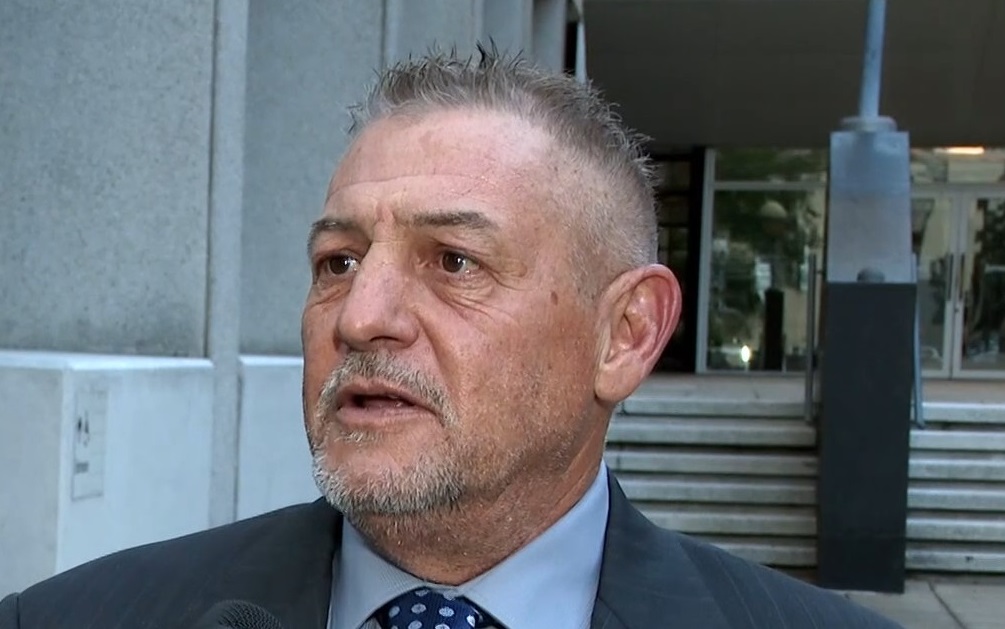
[Photo above: Brian Mannix, a survivor of childhood abuse by George Brignac, speaks outside bankruptcy court in New Orleans on Tuesday, December 2, 2025. Screen image from video report.]
Some who spoke in federal court on Tuesday about being victimized in the Roman Catholic archdiocese of New Orleans’s enduring child molestation saga had forgiven. Others had not.
None had forgotten, even decades later.
That much was clear from what was meant to be the final day of witness testimony in a three-week trial to determine the fairness of a $230 million settlement agreement between the New Orleans archdiocese and roughly 600 people who allege abuse at the hands of priests, deacons and other church personnel.
If it eventually gains final approval as expected, the proposed settlement would conclude a bankruptcy protection case that the US’s second-oldest Catholic archdiocese filed in May 2020 amid the fallout of a decades-old scandal.
Neil Duhon, who was 15 when he was raped at his school by a priest named Lawrence Hecker, was among about 20 survivors who addressed the judge presiding over the trial, Meredith Grabill. From the witness stand, Duhon thanked WWL Louisiana and the Guardian for confronting Hecker on camera, leading to his arrest and guilty plea as charged to aggravated rape and kidnapping in early December 2024. He recalled testifying in front of his rapist as Hecker received a life sentence, providing Duhon hope that his abuser “would spend a long time in prison.”
But Hecker, 93, died within days of his sentencing.
With respect to forgiveness, Duhon said: “I’m still not there.
“I still struggle with that. I … never got to that point.”
Kathleen Austin, who said she was abused hundreds of times by a priest named Gerard Howell starting from when she was a child being raised by deaf parents, echoed some of Duhon’s testimony. She testified virtually that she had grappled with paralyzing flashbacks of her abuse for as long as she can remember, calling them some of the “lifelong effects of the trauma I live with every day.”
Alluding to how Louisiana’s largest archdiocese paid Howell’s full rent, insurance and other living costs for years after knowing he was a child abuser, Austin said: “The church I grew up in didn’t protect me and (continued) to protect their own.
“Why has it taken so long to get to this point – and at such a high cost?” Austin said, referring to how the church had racked up more than $55 million in legal fees heading into Tuesday’s trial finale.
Chris Naquin testified virtually about enduring physical and sexual violence as a child at the notoriously abusive Madonna Manor church orphanage on the Westbank. He said: “No amount of money in the world can compensate what I’ve lost.” He described only just being able to start feeling like an adult despite being in his mid-50s, remarking bitterly: “It’s not fair. It’s really not fair.”
Others conveying similar degrees of pain said they found it within themselves to absolve those who had inflicted abuse on them.
Billy Cheramie said surviving childhood molestation at a church summer camp had burdened him with lifelong depression along with related issues, and it had driven him to join the US military. He testified that he killed enemies in combat, earnestly believing it might help him heal – only to learn it made his pain worse.
“I killed God’s children … for political reasons,” Cheramie testified. “And that really hurt.”
Nonetheless, addressing the outgoing New Orleans archbishop, Gregory Aymond, along with others at the archdiocese, Cheramie said: “I forgive you. I love you. I pray for you.”
Ted Posner testified that sexual abuse as a child at the hands of a priest named Michael Landry had driven him to alcoholism. He had multiple failed marriages and several driving while intoxicated arrests, all of which “destroyed my faith in God.”
“Yet I forgive (Landry) today because I have to – I have to forgive him to be forgiven,” Posner said. “And I have a lot to be forgiven for.”
Those in Grabill’s courtroom heard comparable testimony from Thomas Furino, who reported being sexually assaulted by a New Orleans priest named Brian Highfill while both were at a US Air Force base in Alexandria, La. He said he deeply admired Highfill – before the clergyman exploited the spiritual authority he held in their dynamic to assault Furino.
Furino, too, attributed troubles in multiple marriages to Highfill’s violent betrayal.
“Not being able to have a relationship is terrifying,” Furino remarked. “I don’t know how to do it.”
Still, “I forgive him,” Furino said of Highfill. “I loved him to death. He was like the older brother I wished I had.”
Directing himself to Aymond and other archdiocesan officials, Furino said: “I forgive all of it – I forgive all of you. I have to forgive you.”
Aymond listened intently to those who testified on Tuesday in Grabill’s courtroom. Afterwards, he said it was very emotional to hear the testimony and apologized to those who criticized his handling of the crisis.
Grabill, for her part, told the witnesses they “demonstrated an amazing amount of bravery and courage just by walking through those doors”. She spoke to each one after his or her testimony.
To Austin, she said: “I hear you when you say … it’s affected your entire existence. For that, I am very sorry.”
Grabill has said she anticipated ruling on the settlement proposal’s fairness later in December. In late October, survivors overwhelmingly voted in favor of accepting the deal.
Aymond’s successor, meanwhile, has been chosen: Archbishop James Checchio, who recently arrived from the diocese of Metuchen, New Jersey. He has been tasked with administering the New Orleans archdiocese alongside Aymond before the latter retires in the coming months.
Checchio did not attend Tuesday’s hearing. Sarah McDonald, a spokesperson for the archdiocese, said Checchio was at the Vatican for a meeting that had been scheduled before his appointment in New Orleans.
Survivor Richard Coon – while testifying that he was molested by three men with links to New Orleans’ Catholic church – said, “I am so disappointed,” when he didn’t see Checchio in Grabill’s courtroom.
Another clergy abuse survivor, Tim Gioe, said Checchio’s absence made him feel as if “I’m not being heard still.”
Note: In a video report for this story, we incorrectly reported that Christian Brothers warned the archdiocese of New Orleans about George Brignac’s history of abuse before ordaining him as a deacon in 1976. Brignac was kicked out of Christian Brothers before he was ordained, but it isn’t clear if the archdiocese knew why. Our reporting in 2020 found it wasn’t until later that Brignac’s brother, a priest named HL Brignac, told police Christian Brothers had expelled George for being “too friendly with boys.”