
WASHINGTON (DC)
Encyclopædia Britannica [Chicago IL]
December 4, 2025
By René Ostberg
In 2002, Americans were rocked by a news investigation that exposed widespread sexual abuse of children in one of the country’s largest Roman Catholic dioceses. As reported by The Boston Globe’s Spotlight team, numerous pedophile priests in Boston had been transferred from parish to parish in an attempt to cover up abuse.
Although the Spotlight investigation was not the first exposé of clergy sexual abuse in the United States—or in the global Catholic Church—it had an impact like no abuse revelations before it. Investigations were launched in dioceses around the world. For many Catholics, once they had learned about the abuse and cover-up, there was no going back. As Heidi Schlumpf, the author of Encyclopaedia Britannica’s article on the misconduct, writes, “The sexual abuse crisis has severely damaged the Catholic Church’s credibility and permeates every aspect of life in the church today.”
But what does that mean at the parish level? What impact did the sexual abuse crisis have on the religious beliefs and practices of American Catholics?
Research by the Center for Applied Research in the Apostolate (CARA), a nonprofit organization affiliated with Jesuit-run Georgetown University in Washington, D.C., shows some good news and bad news for the church.
Speaking up and a rebound in bedrock faith
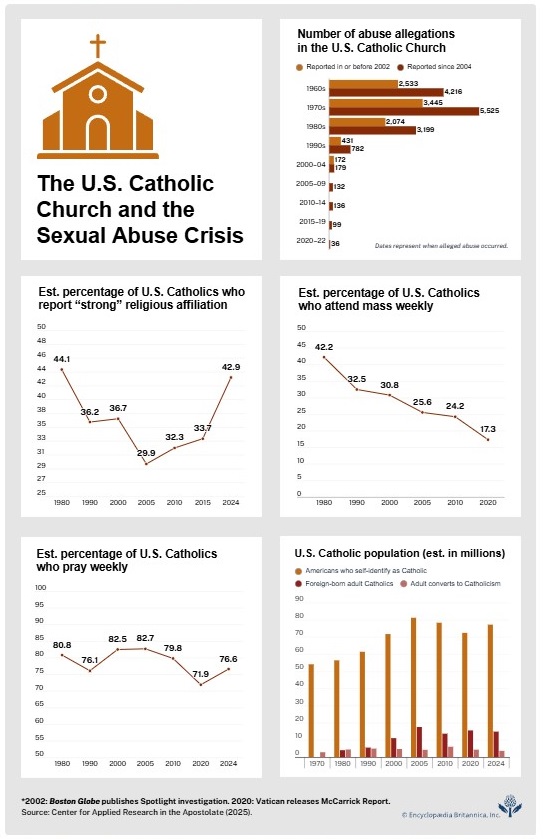
First, the good news. As the first graph in the set above shows, the number of alleged instances of abuse has declined significantly since its peak in the 1970s. What did increase, at least from 2004 (two years after The Globe’s reporting), was the number of people speaking up about clergy abuse, whether it had occurred as far back as the 1960s or in the 1990s or the early 21st century. As horrific as all sexual abuse is, the refusal of Catholics to be silent about abuse any longer is a silver lining.
As seen in the second graph above, American Catholics’ sense of faith has largely rebounded in the wake of the church’s actions to finally address abuse once it was widely publicized. Back in 1980, however, only about 44 percent of American Catholics reported a “strong” religious affiliation. By the 1990s this figure had dipped to about 36 percent. What happened within a decade’s time to cause such a decline in American Catholic affiliation?
Multiple factors influence religious faith, but a growing awareness of the pedophile crisis within the church almost certainly contributed to the loss of faith. In 1985, reports emerged of the crimes of serial pedophile priest Gilbert Gauthe in Lafayette, Louisiana (he was ultimately convicted). Covered by journalist Jason Berry in the National Catholic Reporter and the Times of Acadiana, the Gauthe case is considered to have occasioned the first major news story about the abuse crisis in the United States. By 2005 the percentage of American Catholics reporting a strong religious affiliation had sunk to about 30 percent. But by 2024 the percentage had almost returned to 1980s levels, at nearly 43 percent. Notably, there had been a steady climb back to this level beginning in 2015, two years after the election of Pope Francis. His papacy was marked by historic apologies to abuse survivors around the world and by a 2020 Vatican investigation into the crisis that was prompted by the sexual abuse allegations against former Washington, D.C., archbishop and cardinal Theodore McCarrick (who was eventually defrocked).
Fewer people in the pews
Despite these actions by the church internationally, the Catholic Church in the U.S. has seen declining participation in the central act of worship in their faith: the mass. The third graph above shows a huge drop in the percentage of Catholics who attend mass weekly. In 1980 about 42 percent of Catholics went to mass weekly—presumably, every Sunday. By 2005 this figure had dropped below 26 percent, and in 2020 it sank to about 17 percent. Of course, 2020 was the year that many churches closed their doors because of the COVID-19 pandemic. Yes, most parishes began livestreaming the mass for Catholics abiding by social distancing guidelines. (Indeed, a few pioneering parishes had been livestreaming it even before the pandemic to reach people who are homebound.) But for those faithful who have always adored the “smells and bells” experience of Catholicism or who simply enjoy the sense of community of in-person services, online mass may have been a poor replacement for the “real thing.”
Five years after the lockdown era, however, weekly mass attendance appeared to be on the rise. According to a 2025 report by the Pew Research Center, nearly 30 percent of Catholics stated that they were attending mass weekly or more often. Following the May 2025 election of Pope Leo XIV, a Chicago native and the first U.S.-born pontiff in the church’s history, will American parishes see more people participating in worship services?
Are you there, God?
Throughout the abuse crisis, one steadfast practice among American Catholics was prayer. As seen in the fourth graph above, the share of Catholics who reported praying weekly never dropped below 70 percent between 1980 and 2024. And interestingly, weekly prayer even increased among Catholics about the time of the Spotlight exposé. Whether those prayers were taking place “in the pews,” around the dinner table, or in private moments of reflection, it is clear that American Catholics were seeking someone to hear them in the depths of the crisis.