
ORLANDO (FL)
Orlando Sentinel [Orlando FL]
March 28, 2026
By Stephen Hudak
Florida’s strict legal time limits leave little recourse in long-ago incidents
Steven Langston found himself suddenly wrestling late last summer with disturbing boyhood memories.
They involved church wine, a priest at Orlando’s St. John Vianney School and oral sex, the 54-year-old said.
Why, he asked himself, were these vivid flashbacks haunting him more than 40 years later?
And what could he do about it now?
As it turned out, not much in Florida, where the law works against survivors like him.
[PHOTO: Steve Langston stands outside the Diocese of Orlando offices in downtown Orlando, Friday, March 13, 2026. Langston says he was abused decades ago as a grade schooler at St. John Vianney Catholic School by a priest who has since died. (Joe Burbank/Orlando Sentinel)]
The state imposes tight legal limits on older abuse cases under a 2010 law, and courts have blocked efforts to evade them. And unlike California and New York, where lawmakers opened temporary “lookback” windows to allow otherwise time-barred claims against church leaders, Florida never did.
Amid this stubborn legal climate — and as the nationwide spotlight on church sex scandals has dimmed — the Diocese of Orlando persuaded a judge to quash two highly publicized lawsuits in February. Both involved the actions of a retired priest who was murdered by an alleged molestation victim in Palm Bay in 2024.
In the Sunshine State, claims of long-ago abuse are, essentially, now left to the goodwill of the Catholic Church.
All of which Langston has discovered.
“There’s something wrong here,” he said. “They apologize and say they pray for me, but I will never have my childhood back. I didn’t have the voice to speak up back then, but now I do. I was raped.”
To quell his memories, Langston, a married father of a teenager, began meeting virtually with a therapist, who suggested recollections of grade-school trauma likely had always been lurking in his head, deeply buried under feelings of fear, guilt and shame.
Langston remembered the priest took him to the rectory, made him dizzy with wine and cajoled oral sex from him.
He said the abuse began when he was 7 and continued over a span of four years.
He identified the priest as Father Stephen McNicholas who, he soon learned, was on a 2021 Orlando Diocesean list of 20 church personnel “credibly accused” of sexual abuse of a child or vulnerable adult. McNicholas died in 2011.
Langston also learned “credibly accused” doesn’t always mean the church is admitting guilt, on its part or on behalf of the priest.
But law firms specializing in clergy sex abuse turned Langston away, he said, citing Florida’s time limits.
He decided to reach out to the Diocese of Orlando, connecting with Dorothy Rivera, the diocese’s victim assistance coordinator and a retired Orange County sheriff’s detective with experience investigating sex crimes.
They traded emails, some of which Langston shared with The Orlando Sentinel.
In the correspondence, she said she would present his claims to the Diocesean Review Board, a local panel created in most Catholic dioceses in the early 2000s to review abuse allegations in the wake of the Church’s global sex scandal.
The five-member board, composed mostly of lay persons who act in an advisory role to the bishop, includes a priest but also must include a sex abuse survivor, a mental health professional whose practice focuses on victims and/or perpetrators of child sex abuse and recovery, and a law enforcement representative.
According to the diocese’s website, members of the review board “should be individuals of outstanding integrity and good judgement in full communion with the Church.” The site says the board “meets as needed.”
Rivera’s emails were congenial but, for Langston, not hopeful, he said. She wrote:
“I hope this message finds you well and that you are continuing to find healing and strength through your work with your counselor. Please know that you remain in my prayers, and I ask the Lord to grant you peace and comfort as you continue on this journey.
“I have reviewed your claims again with the Review Board, including your emails. Other than your allegations, there is no evidence that we can find indicating Fr. McNicholas abused you or any other child at St. John Vianney School. We have reviewed and researched your emails about his alleged history. The emails are inaccurate in many respects. For example, Fr. McNicholas does not appear on any other diocese’s credibly accused list.
“Our investigation has been hindered by the lengthy passage of time since the alleged incidents and Fr. McNicholas’ death many years ago. We want to help you, but there’s only so much we can do given that the events occurred about 50 years ago, and we have no other evidence.”
“I feel like I’m being called a liar,” he wrote in reply. “I am the evidence.”
The diocese offered $10,000 to Langston to cover a year’s worth of continued therapy, emails show.
Langston said he wasn’t expecting a jackpot but he deemed the diocese’s offer an insult, saying it amounted to 59 cents a day since he was first abused and minimized the subconscious angst he believes bent the arc of life.
He asked for $10,000 for each of the 46 years he lived with the trauma, then doubled the demand.
Langston admits he has a prison record and is a recovering alcoholic.
Court records show he pleaded no contest in 2013 to five counts of dealing in stolen property — a gold chain and other jewelry he lifted from the Orlando pawn shop where he worked. After serving 24 months of a 28-month sentence, he was supervised by a state probation officer who signed off on an early release, telling the judge that Langston had satisfied all court-ordered obligations, including $20,000 in restitution.
During their correspondence, Rivera proposed that Langston meet in person with her and diocese lawyer Kevin Shaughnessy.
On March 12, Langston flew from North Carolina, where he lives, and sat with Rivera and Shaughnessy in a hotel hospitality suite near the airport to discuss what Langston alleges Father McNicholas repeatedly did to him from 1977 through 1982 while Langston was a grade-schooler at St. John Vianney School on South Orange Blossom Trail.
He then met with a Sentinel reporter before flying home.
Over lunch with the reporter, Langston praised his wife for sticking by him “definitely more than most would” as he has worked through old memories and bad feelings. He said they’ve known each other since they were teen-agers.
“She’s nervous for me,” Langston said. “It’s put a strain on us. It’s affected our intimacy, even just holding hands or hugging, but she sees I’m dealing with a lot of old baggage and doing the best I can.”
He said he no longer drinks alcohol.
“I tell people I’m allergic to it. I break out in handcuffs,” he quipped.
Langston said Rivera and Shaughnessy listened patiently and politely during the morning session, but probed his recall, asking if anyone – a classmate, a teacher, a guidance counselor or school principal – might be able to verify his claims.
He said he had told no one, not even his mother, for fear he would be scolded because his parents had “spent good money” to send him and his older sister to St. John Vianney. The family lived in Kissimmee and weren’t regular church-goers.
Langston said Rivera would not say why McNicholas was on the diocese’s “credibly accused” list.
The current version of that roster was posted in 2021 to little public notice, 10 years after McNicholas’ death. The document describes its contents as “church personnel removed based upon a credible allegation of sexual abuse of a child or vulnerable adult,” and includes some notorious pedophile-priests. Among them is William Authenrieth, for whom the Diocese of Orlando reportedly paid more than $2 million to compensate four victims after multiple lawsuits.
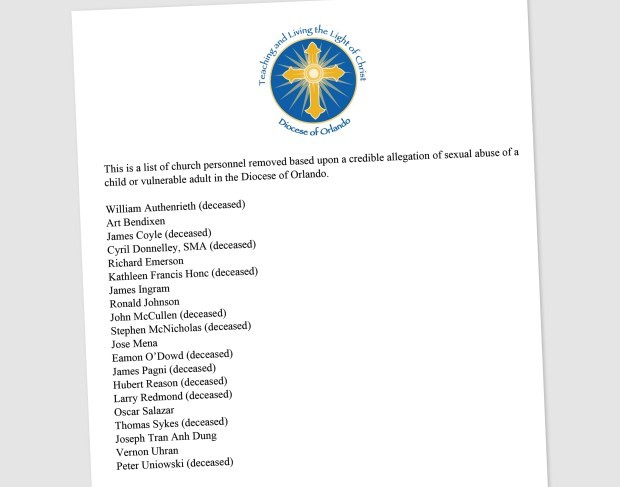
McNicholas, in contrast, had never been publicly identified as a possible abuser before his appearance on the list.
The Orlando Sentinel featured the Ireland native McNicholas in a 1968 article about St. Patrick’s Day. He revealed that he had left home at age 16 and studied in Rome with an Italian order of priests.
The article reported that the priest was ordained in 1953, had arrived in the U.S. in 1961, was assigned to a parish in Peoria, Illinois, and then transferred in 1966 to Orlando, serving at St. John Vianney. No other information about him could be found in the paper’s archives.
Herman Law and Horowitz Law, two firms that have won large settlements in priest sex abuse lawsuits, have posted short biographies of “credibly accused” clergy on their websites. Neither has much detail on McNicholas, for whom an obituary also was not found.
Contacted by the newspaper, both Rivera and Shaughnessy declined to answer questions, referring a reporter’s inquiries to the diocese’s senior communications director, Jennifer Drow. She replied by email, “The Diocese of Orlando has handled Mr. Langston’s concerns in accordance with our policies, and we cannot comment further on his allegations.”
Drow said the policies are spelled out in detail on the diocese’s website under the headings of Safe Environment and Accountability, which direct complaints to be made first to the Department of Children & Families toll-free abuse registry hotline.
The number is 1-800-962-2873. Callers can speak with an operator in English, Spanish or Creole.
Once a complaint is made, the diocese’s victim assistance coordinator is then notified; the suspected abuser is removed from his/her current position, if any, pending a law enforcement and internal investigation. The victim assistance coordinator starts an investigation quickly – no later than a week after notice – and then consults with the Diocesan Review Board, the Diocesan Attorney and possibly others.
Recommendations of the Review Board are then presented to the Bishop.
“Any form of sexual misconduct is sinful in the eyes of God. Certain forms of sexual misconduct can be criminal as well,” the website notes.
Advocates and lawyers who have represented survivors of priest sex abuse say later life epiphanies like Langston’s are not uncommon, often unearthed in counseling sessions for other issues.
“They’re not the majority, but they’re not rare either,” said Jenny Rossman, an attorney with Herman Law and a former assistant state attorney who prosecuted sex crimes in Orange and Osceola counties.
But those lawsuits, like others across Florida, today have trouble finding traction.
“Florida is stuck in time and refusing to follow the national trend,” said attorney Adam Horowitz, who filed in 2014 an early claim against the Diocese of Orlando after Pope Francis called on the church to make reparations and weep for its sex abuse victims.
“Across the country, states have reformed their laws to give survivors of childhood sexual abuse a path to justice — even decades later — because they understand that trauma often delays disclosure. Florida hasn’t,” Horowitz added. “Powerful insurance companies are among the most influential lobbyists in Tallahassee, and they’ve helped block those reforms. The result is that many survivors here are shut out of court entirely, not because their claims lack merit, but because the law hasn’t caught up.”
The Sentinel reviewed court filings for the last ten years in each county in the Diocese of Orlando. Only a handful of cases have been filed during that time, three on behalf of clients who alleged they were sexually abused by “Father Bob” Hoeffner, 76, the retired priest shot to death at his Palm Bay home in January 2024.
A sister of Father Bob said he had a “weird” relationship with his alleged killer Brandon Kapas, 24, who died in a shoot-out with police. Afterwards, Kapas’ aunt told police she suspected the priest had molested her nephew, though the young man never told her that, according to a police investigative report.
The main legal obstacle to these cases comes from a 2010 state law which lifted the statute of limitations for certain claims of abuse involving children under 16, but clamped down on claims in older incidents.
A series of court rulings since have throttled victims’ efforts to find resolution, specifically rejecting cases arguing delayed discovery or “repressed memory,” as in Langston’s case, could justify abuse claims not made in a more timely fashion.
Nonetheless, lawyers persist.
Rossman is appealing a judge’s ruling in favor of the Diocese of Orlando in the lawsuits filed last year on behalf of three plaintiffs, two identified as John Doe I and John Doe II, who claim they were molested on a canoe trip by Hoeffner.
In those cases, lawyers for the diocese argued the plaintiffs’ claim of “intentional infliction of emotional distress” was a strategy intended to dodge the statute of limitations for negligent supervision. The February judicial order dismissing the cases noted some of the claims were “time-barred” while others were based on legal theories that “Florida law does not permit.”
[PHOTO: Shawn Teuber looks at a poster outlining the career of father Robert “Bob” Hoeffner, during a press conference after his attorney Jeff Herman filed a lawsuit against St. Joseph Catholic Church and School, on Friday, May 30, 2025. Plaintiffs are finding that under Florida law, many of their legal claims are time-barred. (Ricardo Ramirez Buxeda/Orlando Sentinel)]
Rossman said the restrictive statute of limitations impede abuse survivors’ quest for justice.
“Without legislation that creates a window for survivors to bring previously time-barred civil lawsuits against institutions, like the Catholic Church, for sexual abuse suffered as a child — like was done in New York and California — survivors in Florida are left without a civil remedy against these institutions whose negligence resulted in their sexual abuse as a child,” she said.
This past December, the Archdiocese of New York agreed to mediation to settle sex abuse claims of 1,311 accusers dating as far back as 1952, the Reuters News Service reported. The lawsuits forced the archdiocese to sell real estate holdings in hopes of raising $300 million for victims.
Langston’s life challenges are “incredibly common” among sex-abuse survivors, especially those who were abused as very young children, when they were more likely to lack language to articulate what happened to them, said Jessica Schidlow, a children’s rights law expert with Enough Abuse, a Boston-based advocacy organization.
“And then there’s the shame, the fear of not being believed, particularly when it involves a community institution like the Catholic church or a priest sometimes regarded as essentially an extension of God,” she said.
While many victims sue as “John Doe” to protect their identities, Langston said he was willing to risk embarrassment and relive his childhood pain so no child has to experience what he did. He plans to create an advocacy web site to remind sex abuse survivors, “It’s not your fault.”
Asked if his experience has shaken him spiritually, he said he remains a believer.
“I consider myself Christian but do not attend any churches,” he answered in an email. “Just can’t get with any churches.”
By Stephen Hudak | shudak@orlandosentinel.com | Orlando Sentinel
Staff writer Silas Morgan contributed to this article.