
ASUNCIóN (PARAGUAY)
Los Ángeles Press [Ciudad de México, Mexico]
March 16, 2026
By Rodolfo Soriano-Núñez
A letter from 14 lay leaders at Paraguayan parish uncovers what lies behind clergy abuse in Latin America and elsewhere.
The same day the letter was signed, Cardinal Adalberto Martínez called to reject abuse while concelebrating a Mass with a priest credibly accused of abuse in Paraguay.
The letter, an oddity in Latin American Catholic contexts bypasses the Paraguayan Catholic hierarchy seeking help in Rome.
For most Latin American Catholics, the very name of Paraguay, the country and the river nursing the capital of Asunción, brings to the memory the episode, brilliantly captured in the 1980s movie The Mission, of the brave resistance of the Guarani communities opposing the Portuguese take over of what were their ancestral boundless lands.
Paraguay remains a bastion of Catholicism in Latin America. When one goes over its numbers is the “most Catholic” country in the region, as the story linked after this paragraph told back in September, and yet one must wonder for how long.
Sadly, over the last 20 years or so, Paraguay, as the rest of Catholic Latin America has learnt a bitter truth: even if there were episodes where Catholicism protected the weakest, rural, marginalized, First Nations communities, bishops and superiors from Latin America itself, the United States and Canada, several European countries and Rome, have used its communities to hide sexual predators.
Now that the development of the Internet and social media facilitates having access to information and peer-to-peer exchanges in a relatively homogeneous region such as Latin America, is hard to dismiss the voices coming from Paraguay. Unlike what happened in the 18th and 19th centuries when the Church stood with the weakest in Paraguay, these days what comes from Paraguay is the signals of the infliction of pain upon the Catholic communities there.
Early on Sunday, Los Angeles Press received a two-page letter dated February 3, 2026. The letter is the very definition of an S.O.S. As such, it was not addressed to us, but to the superior general of the Oblates of Mary Immaculate, a religious order that, as many others in the Catholic Church these days, has a known record of abusive, predatory practices, documented from the frozen Tundra in Canada and Alaska, all the way down to the warm and humid pampa in Argentina.
The superior general is Luis Ignacio Rois Alonso, a priest born in Spain in 1963, who was originally ordained back in 1988, and who was elected for his current position in 2022.
A desperate plea
The letter is a plea, probably a desperate move made by 14 laypersons at the parish of San Blas– Loma Pytã, whose names and identities will remain anonymous for the purposes of this story, Their names, however, are known to the Oblate leadership and through them to the Catholic hierarchy in Paraguay so, to be sure, if something happens to them because of the reaction of overzealous clerics or laypersons in Asunción, it is not because the media is trying to bring trouble there, but because of the mechanisms to punish dissent and criticism of the hierarchy’s behavior documented in the previous installment of this series.
The letter is available after this paragraph in its entirety in Spanish first, with the names of its signatories blackened, followed by an unofficial translation, as a PDF.
The letter by the 14 lay members of San Blas parish. Original in Spanish first, English translation after.
And to be clear, it is never easy in Latin America to get 14 laypersons close to their parish or diocese, to sign a letter asking the general superior of the order to intervene in a parish matter. That is an “ordinary miracle” more so as the signatories are willing to identify Zenon Berikani, the parish pastor, by name. Unlike the common practice Latin American Catholic “legalese” of mind-bending elliptical references, they are clearly stating the source of their pain.
Then and there that is already another “sign of the time” about the depth of the crisis at oblate order in Paraguay and elsewhere, more so, as in going all the way to Rois Alonso, the 14 lay signatories are bypassing the archbishop of Asunción, the nation’s capital, Adalberto Martínez Flores and the Oblates’ superiors in South America, Sergio Rubén Serrano, who decided early in 2025, to propose Berikani as the pastor of the parish.
As respectful and careful as the letter is, it is a summary of a systemic crisis at the parish. It is a rosary of grievances pointing to Berikani. The grievances are more relevant as tracking down who he is not an easy task, a relatively recent arrival to Paraguay, there little or nothing about him in the English- and Spanish-language internet. Even if there is a Facebook personal profile bearing his name, it is impossible to figure out if it is his or a namesake, as the profile is almost empty.
Trusting the abuser
And the issue is not an overbearing or distrustful local bishop. Quite the opposite, back in December 2025, Cardinal Martínez Flores was more than willing to support Berikani and the Oblates’ order at large. Then he presided a major celebration for the Paraguayan Catholic Church: the centennial of that order’s arrival to Paraguay, as the section “Back to Paraguay” of the story linked after this paragraph told at the time.
As far as the Oblates’ leadership is concerned, the letter is a direct challenge to the administrative oversight of Argentine priest Sergio Rubén Serrano, OMI, head of the Cruz del Sur Province. As provincial he controls a unified administrative block spanning Argentina, Chile, Paraguay, and Uruguay, managing a vast network of parishes and schools.
Despite his power, the 14 signatories in Loma Pytã already see him as unwilling to pay attention to what happens in San Blas, forcing them to bypass the entire Southern Cone hierarchy to reach the General Curia in Rome. In that regard, the S.O.S. letter is a direct indictment of the regional oversight provided by Serrano.
The Oblates’ vast administrative network, managed from Buenos Aires, has effectively discarded the individuals within its ranks. For the 14 lay members of the San Blas parish, the source of the pressure to turn their community into an ATM is irrelevant; they only know the squeeze is real. Whether the mandate is a provincial directive from Serrano or a local requirement for Martínez, the result remains an institutional environment where ‘economic goals’ have liquidated the mission.
The pressure put to collect tuition fees is more complex to understand as Catholic schools in Paraguay operate in what could be seen as a parallel reality.
Both the parish and the Catholic school managed by Berikani on behalf of the Oblates benefits from a total exemption of property taxes and generous public subsidies for its staff.
Predatory lending
Despite that, the Oblates treat their own parishioners and students with the cold efficiency of a predatory lender. By documenting the threats of disenrollment and the hostile treatment of mothers unable to pay the fees, the 14 signatories expose a story way too common in Catholic schools all over Latin America. Parents facing hard times find the hard way the limits of Catholic charity.
In any case, the pressure to achieve “goals” probably it is a combination of many issues, what is clear, however is that, on top of the pressure to achieve “economic goals” there is also a disconnect between Berikani and permanent deacon Fulvio Pérez.
Pérez is a survivor of a stroke. The expectation for any Catholic parish, is that when dealing with a deacon who survives a stroke, he would be a focal point of community care. At San Blas, he was treated as a liability to be liquidated.
The 14 lay members of San Blas agree that among the many difficulties Berikani has when performing as pastor of the parish is how he targeted Pérez with his own brand of “derogatory” mockery. Following a stroke, deacon Pérez found that his years of service, his opinions about how the parish deals with its own issues were irrelevant for Berikani who, instead, in Trumpian style weaponized his physical sequels rather than offering him Catholic and oblate charity.
The letter then goes into the ever-fractious territory of the way Catholic clergy address and relate to females, whether as part of their flock, subordinates or colleagues.
As far as the letter is concerned, Cardinal Martínez, provincial superior Serrano and the Oblates’ global leader should be concerned with both how Berikani addresses and deals with female faithful and the mothers of the students at the Catholic School connected to the parish, but they also warn about Berikani’s own relation with the academic manager (secretaria pedagógica) of the school.
That is, by the way, the portion of the letter where a reader with knowledge of the intricacies of Catholic education in Latin America must wonder what is really behind the lay members carefully crafted complaints.
The issue of Berikani’s relationships with females is more relevant as the San Blas parish is already a refuge, a sanctuary of sorts, for Rafael Fleitas López, a Paraguayan oblate Los Angeles Press has been tracking down since 2024.
Fleitas, the passenger
He is a Paraguayan priest, an oblate. When this series first tracked him, back in March 2024, as the story linked after this paragraph proves, he was scheduled to complete an opaque transfer from General Artigas, a town in Southern Paraguay, near the border with Argentina, to a rural parish in the state of Oaxaca in Southern Mexico.
It was a message from the Argentine Survivors Network of those Abused by Priests that caught the attention of this series. Since then, the series has been following, mostly through unofficial channels, Fleitas López’s whereabouts.
As the story linked before this paragraph tells, it was possible to see, over the pictures shared by the order’s social media accounts that by then he had been already living in Mexico; he concelebrated Masses, heard confessions, and even had some academic activities, despite being under some sort of “soft” suspension in Paraguay and other South American countries.
T
To the right, Rafael Fleitas López during the Ash Wednesday rituals at San Blas, Asunción, Paraguay. March 5, 2025. Social media of the San Blas parish.
Fleitas López was only waiting for the ceremonies of transfer of the pastoral teams in the parish he was scheduled to serve as part of an Oblate team in a diocese in the Mexican state of Oaxaca.
The tracking was necessary because, as that story proved, there was and still is a profound double institutional silence from both the Catholic Church and the Paraguayan government regarding an accusation brought against Fleitas López by a female parishioner who lives in General Artigas.
Such silence, an echo chamber of sorts where the one’s silence was mirrored by the other’s, following different rationalities, has had severe consequences for his victim and her relatives.
In this specific case, the victim’s brother’s search for justice has become a proxy for his sister’s stolen voice, her illness and pain have turned into a shared pilgrimage through a void where the Church’s canonical, pontifical, silence and the Paraguayan State administrative neglect create a single, suffocating experience of familiar victimhood. It is not only the sister, or the sister and her brother trying to help her. It is the whole family, and their neighbors in General Artigas who experience the pain.
Grueling lessons
Tracking down Fleitas López, in that regard, has been a grueling series of lessons in the theology of impunity, a dive into the deeply disrespectful attitude with which the Oblates, the Catholic Church at large in Paraguay, and the Paraguayan authorities dismiss a victim’s experience, that of her relatives, and the ease with which Paraguayan and Mexican Catholic leaders are willing to put their flocks at risk.
While Fleitas López was being moved across borders, the way an episcopal crosier would be sent from Buenos Aires to Bogotá and from there to Mexico, the victims were left to navigate the void of silence.
For the Church’s hierarchy, no news is good news, as they see the stagnation of any claim as success, an element of a calculated strategy to exhaust the survivors into submission. For the victims and their relatives no news is the confirmation of how little they actually mean for the hierarchy, how distant is their actual, lived experience, from the refined statements that over the last 45 years or so John Paul II, Benedict XVI, Francis and more recently Leo XIV have made regarding the clergy sexual abuse crisis.
The Oblates of Mary Immaculate, sometimes known as Missionaries Oblates of Mary Immaculate and usually referred only as Oblates are a religious order, originally born in France, with a known record of repeated abuse, some would describe it as systematic, a notable allergy for transparency and accountability and poor mechanisms to prevent clergy sexual abuse in the facilities under their care.
Despite the meaning of oblate, one who offers himself to the service of God, the Church, and others, the U.S. NGO Bishop Accountability has been able to identify over almost two decades that it has been working a minimum of 60 priests and brothers associated at different times with that order with a known record of abusive or predatory practices.
Ordinary miracle
That is why the “ordinary miracle” of the 14 lay members of the San Blas parish is more relevant. They, as much as the victim from General Artigas and her relatives, are trying to put an end to the void.
While the Oblate order—from the provincial office in Buenos Aires to the General Curia in Rome—continues to treat its mission as a series of economic goals, the 14 signatories at San Blas provide a painful account of the consequences of their managerial style.
Sadly, there are more lessons coming from San Blas. The very same day the 14 lay members were willing to put sign their letter to Rois Alonso, Cardinal Martínez Flores was willing to double down his bet on the Oblates.
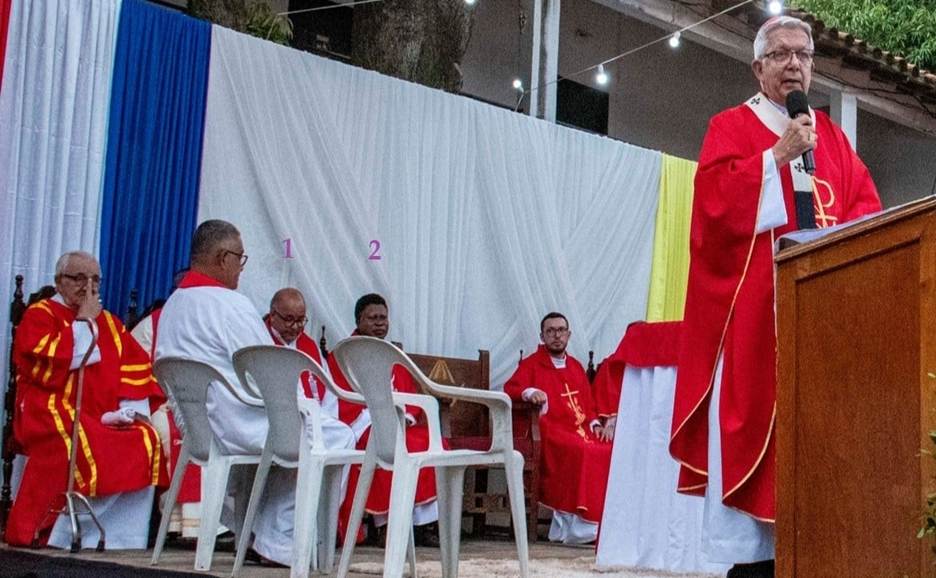
As it happened already during the Mass Martínez Flores presided back in December, the Cardinal was willing to concelebrate again with Fleitas López, implying that, at least as far as the Archdiocese of Asunción is concerned, Fleitas López’s is still a legitimate Catholic priest, despite his record of abusive behavior.
Main problem, of course, is that the victim who lives in General Artigas is still waiting for some official communication from the Oblates, from Rome, and more so from the Paraguayan authorities.
That is why it is easy to understand why Paraguay Catholicism is at a crossroads with a hierarchy very willing to talk as much as possible Pope Francis’s and more recently Pope Leo XIV’s talk but unwilling to walk the way they walk on the issue of clergy sexual abuse.
The result of such disconnect is a perception of contradiction in the Cardinal’s own homily the very same day the 14 lay members of San Blas gathered the required strength and courage to sign the letter with their names.
That day, the Cardinal was even willing to denounce abuse and human trafficking as evils Catholics must forcefully reject. At some point in his homily, he goes as far as to say:
“Today, as yesterday, the Church needs Christians committed in the family, in the school, in the work, in politics and in society. We cannot separate faith from life, nor prayer from justice, nor communion from solidarity. Every baptized person is a missionary in their own environment.
“Jesus identifies himself with the small, the poor and the fragile. Every form of abuse, human trafficking, violence or exploitation wounds Christ himself. We renew our commitment to safe, healing and merciful communities.”
A screenshot of the message posted at Facebook by the archdiocese of Asunción on February 4, 2026. Highlighted in yellow, Rafael Fleitas López’s name.
The original of his homily is available here at his archdiocese’s website (content in Spanish), or here at the archdiocese’s Facebook account or the image before this paragraph prove, in both cases only in Spanish. The same text with an English translation appears, as a PDF, in the box after this paragraph.
Cardinal Martínez Flores’s homily, February 3, 2026, English-language translation after Spanish original.
Is he aware?
It is unavoidable to notice, as far as his message in Facebook is concerned, that he explicitly acknowledges Fleitas López as one of the Oblates working at San Blas. Is the Cardinal aware of Fleitas López’s attacks on parishioners in General Artigas? That is something only him knows, but it would not be the first Cardinal who claims “knowing nothing” about a priest under his supervision.
In doing so, top Catholic clerics such as Martínez Flores only dig deeper in the ever-worsening saga of the clergy sexual abuse crisis in their church. Him and many others in the College of Cardinals seem unaware of the effects the perception of betrayal and a certain dose of fear emerging in exchanges over WhatsApp and other peer-to-peer messaging services where Paraguayan citizens request anonymity as soon as they mention the names of priests perceived as playing a role in the cover up of sexual abuse.
That perception of betrayal is aggravated by how the archdiocese of Asunción has legitimized the rehabilitation of Rafael Fleitas López. If by the end of last year, he was already visible in videos coming from the parish of San Blas de Loma Pytã in the archdiocese of Asunción—as chronicled by this series in the story linked below—on February 3, 2026, Cardinal Adalberto Martínez Flores returned to that same altar for another major celebration.
Furthermore, the Cardinal’s behavior confirms the underlying assumption of this series about that predators, in Latin America and elsewhere. They are not “lone wolves,” “rotten apples,” or “lone predators,” they are the byproduct of lax and opaque Church and/or State institutional environments.
Also, one must keep in mind that Fleitas López’s rehabilitation has been an operation executed from different fronts. Back in August 2024, the story linked after this paragraph included an update about Fleitas López after he joined other Paraguayan priests in the ordination of a new priest, as told in the section “Eight is charm” there.
They have been able to abuse the way they do because, at least as far as Latin America is concerned, there are no State-sanctioned and enforced mechanisms to enforce transparency and accountability and little or actual consequences for the individuals or the institutions involved as they have been painfully developed in the United States over the last 40 years or so.
Also, unlike what happens in the German and French conferences of Catholic bishops, there is no will to actually acknowledge the truly devastating effects of clergy sexual abuse, as several installments of this series have proved over the last three years or so.
In any case, Martínez Flores, who is about to reach 75 and send his resignation letter to Rome, presided over the Mass to celebrate Saint Blaise (Blas) of Sebaste, the 4th-century bishop and medical doctor who is the Saint Patron of Paraguay. The irony is staggering: while the Cardinal celebrates a Saint Doctor from Roman Turkey, he does so alongside a man whose presence represents a festering wound for at least a family in General Artigas in Paraguayan South.
Even if Fleitas López remains in the secondary roles he has occupied for most of his career, the archdiocese’s official Facebook account explicitly identifies him as part of the team at San Blas.
Perhaps this is Cardinal Martínez’s “princely manner” to let his flock know he has granted a second, perhaps third or fourth chance (God and the Oblates only know), to the very man this series has tracked from the border of Paraguay and Argentina to the rural parishes of Oaxaca and back.
The victim’s brother is anything but defeated. He remains committed to seeking justice for his sister. Most recently he filed a petition asking the Paraguayan national authorities to set the record straight regarding Fleitas López.
One thing is for sure; he is in no condition to offer the kind of bribes the District Attorney in the Alberdi case was trying to get to bury a case, a story to be developed next week. His only currency is a truth the State and the Church find too expensive to acknowledge.
At center, holding a wooden crosier, Cardinal Adalberto Martínez Flores, archbishop of Asunción, Paraguay at the parish of San Blas, December, 2025. Social media of the Oblates of Mary Immaculate.
* * *
A summary of this piece is available as audio after this paragraph.
Note on production: The text of this summary was written and edited solely by the author. The delivery of the audio summary was achieved using a high-quality, text-to-speech engine Microsoft Word for Web. The AI was used for voice generation only, not content creation.