
MEXICO CITY (MEXICO)
Los Ángeles Press [Ciudad de México, Mexico]
December 1, 2025
By Rodolfo Soriano-Núñez
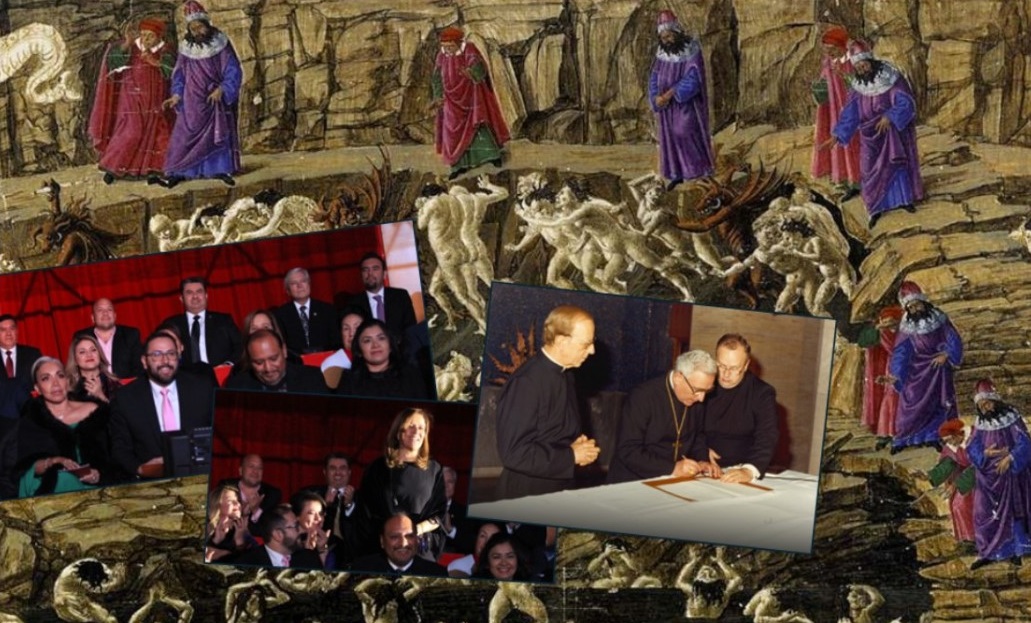
[Graphic above: The sources of impunity for Mexican predators in religious settings: The protection they provide to each other, and the protection the political elites give them. Composite graphic by the author; classical art reference and photo credits in a final note.]
Mexico and France are both on track to change their national laws to deal with sexual abuse, in religious settings or otherwise.
“Old” abuse cases haunt the Catholic Church all over the world. For the last decade, the French bishops have actively sought to address them.
Unlike France, Mexican bishops avoid acknowledging the true extent of the abuse crisis and yet new and “old” cases emerge and undermine their credibility.
Last week, the world marked November 25 as the Day against gender-based violence. Italy set feminicide as a specific type of crime, carrying the highest penalty possible under their laws: prison for life. Government officials in France and Mexico introduced bills to reform their laws as to reduce different types of gender-based violence.
A feature of the French bill, available here (content in French) is its interest in facilitating report of that kind of violence. Such design centered on facilitating report reflects the effects of a national reckoning about the large scale of sexual violence, after details of several high-profile cases.
Among the most notable, that of Gisèle Pelicot, and the shocking revelations of the extent of abuse in several Catholic schools, non-profits, and movements, and even families, as proven by the testimonies of individuals calling out their own fathers, and even their mothers, for having sexually abused them, as proven by the testimony in this French TV program (audio in French).
Mexico lacks a similar reckoning as to the extent of sexual violence, religious or otherwise. Most of the few Mexican survivors who have achieved some measure of justice in courts, have only been able to do so over United States courts.
This has happened in the Catholic and Luz del Mundo churches. With the Catholic Church first, after the probes into what was happening at the archdiocese of Los Angeles in the late 1980s, with at least one Mexican priest sent there by now-emeritus archbishop of Mexico City, Cardinal Norberto Rivera Carrera .
Although the Angelenos victims of Mexican priest Nicolás Aguilar Rivera were able to achieve a measure of justice, as part of a broader agreement on clergy sexual abuse in the archdiocese of Los Angeles, only some of the Mexican victims of the very same priest did and only through the U.S. system of justice.
Other Mexican victims Aguilar Rivera assaulted in their own country are still waiting, many years after, for some measure of justice in Mexican courts. Not that the Mexican courts were unwilling to acknowledge what Aguilar Rivera was doing. He was actually found guilty by a Mexican judge back in 2003, but his sentence was to only one year prison and, as if to add insult to injury, it was commuted after nine months.
Eight years later, as the story linked in the previous paragraph proves, that prompted some Mexican victims to seek the help of a U.S. judge to consider their case through the Alien Tort Claims Act, and it was only then, through that extraneous process, that they were able to achieve a ruling in their favor.
Something similar has happened over the last ten years or so with the leadership of the Luz del Mundo (Light of the World) Church. Back in the mid-1990s, local media in Guadalajara published reports about the extent of the abuse perpetrated by the then leader of that church, Samuel Joaquín Flores.
As it happened too with Marcial Maciel, the media case against the leaders of the Luz del Mundo Church was originally built by English-speaking U.S. media, willing to voice the testimony of victims of Mexican origin in California.
Although since the 1990s there has been pressure on the state (Jalisco) and federal authorities in Mexico to pursue similar accusations against Samuel Joaquín Flores, they crashed with walls of complicity, built over many years of his church acting as a very efficient voting bloc in local elections in the Guadalajara metropolitan area and in Jalisco state politics.
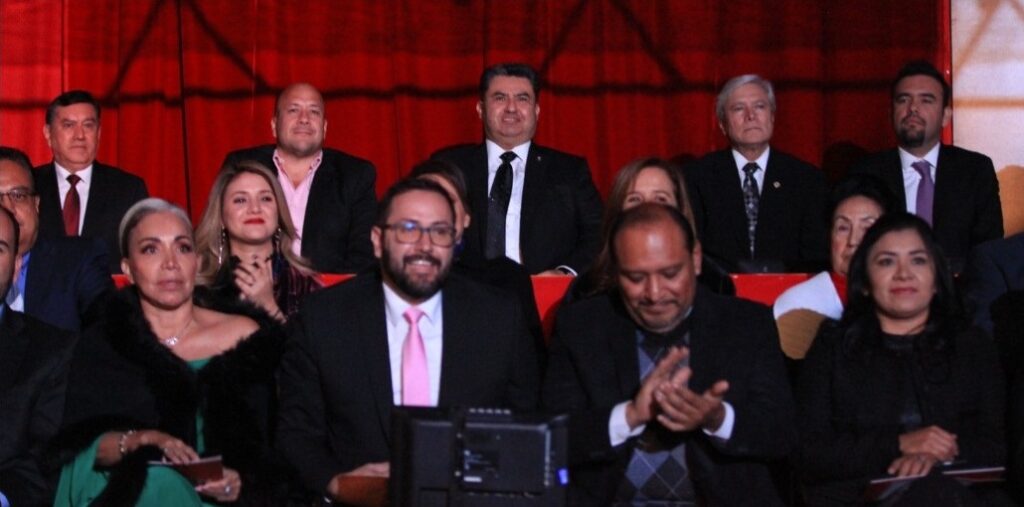
It was in the United States where the legal reckoning began. Starting in 2019, the many rumors and accusations of abuse against the Luz del Mundo church led to a trial in California state courts, which concluded in 2022 with the conviction of Naasón Joaquín García, the biological son of Samuel Joaquín and then-leader of the religious organization, for large-scale sexual abuse, issuing a 16-year prison term sentence.
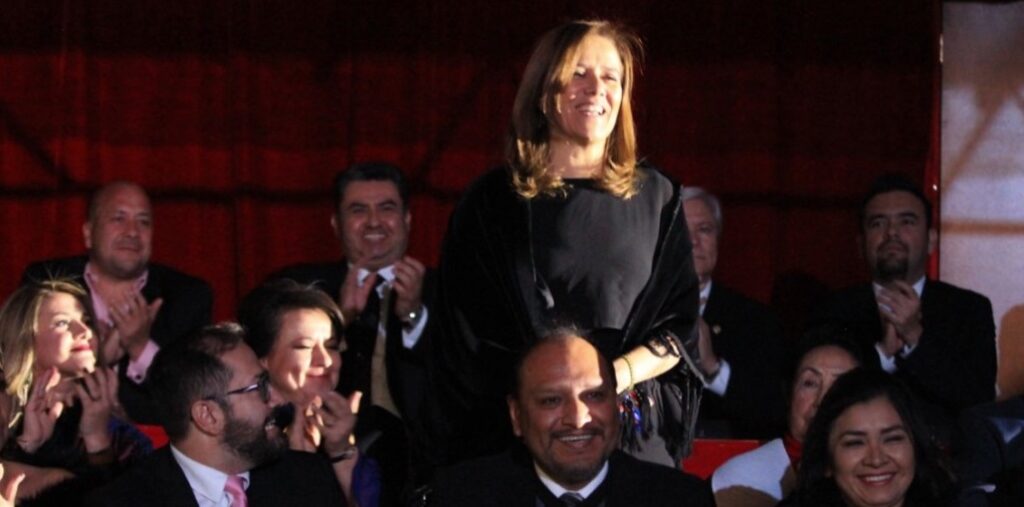
That action has since escalated. More recently, in September 2025, a wider federal net was cast. Naasón Joaquín García and an ensemble of allies and relatives, including his mother, now face separate charges of sexual abuse and sex trafficking in a federal court in New York City.
Denial is not a river in Africa
Despite the relatively intense debate about Marcial Maciel’s legacy in Spanish- and English-language media, the Mexican Catholic Church has never actually addressed the issue. The Apostolic Visitation finished in 2010 set in stone the notion of Maciel as a mythical character, the “abominable lone predator,” as several installments of this series have described him, the most recent linked after this paragraph.
Examining no. 2 of the Press Release published on May 1, 2010, (opens content in Spanish), one reads, as translated by the author of these lines:
2. The Apostolic Visitation has been able to attest that Fr. Marcial Maciel Degollado’s behavior has had severe consequences in Legion’s life and structure, up to the point that a path of in-depth review is necessary.
The extremely grave and objectively immoral behavior of Fr. Maciel, confirmed through unassailable testimonies, represent in some case through crimes and reveal a life absent of scruples and through religious sentiment. Said life was unknown for most of the Legionaries, more so because of the system of relationships built by Fr. Maciel, who was able to craftly built alibis, earn the trust, closeness, and silence of those who were around him and heighten his own role as charismatic founder.
The 2009-10 visitation allowed the Legion of Christ to manage, in their own terms, the crisis that, as previous installments of this series have proved are affected by the myth of Maciel as a lone predator and keep failing to actually prevent abuse, as it was proven in the story linked after this paragraph.
Unlike the now suppressed Peruvian Sodalitium of Christian Life, whose leaders decided to go to war with late Pope Francis himself, as to deny any wrongdoing, the Legion of Christ has been willing to accept the slaps on their wrists given by Francis and, before him, by Benedict XVI, while keeping and even furthering the toxic myth of Maciel as the “lone predator,” barely toned down by the sparse use of the “rotten apple” metaphor.
Far from a sweeping reform of Maciel’s “order,” the Legion’s discipline towards Rome has been rewarded. Fernando Vérgez Alzaga, became the first active member of the Legion to get into the College of Cardinals, while a former member of the order, Cardinal Kevin Joseph Farrell, presides over two key Pontifical bodies, that of Investments, and the one dealing, to nobody’s surprise, with Confidential Matters, the keeper of the most sensitive secrets.
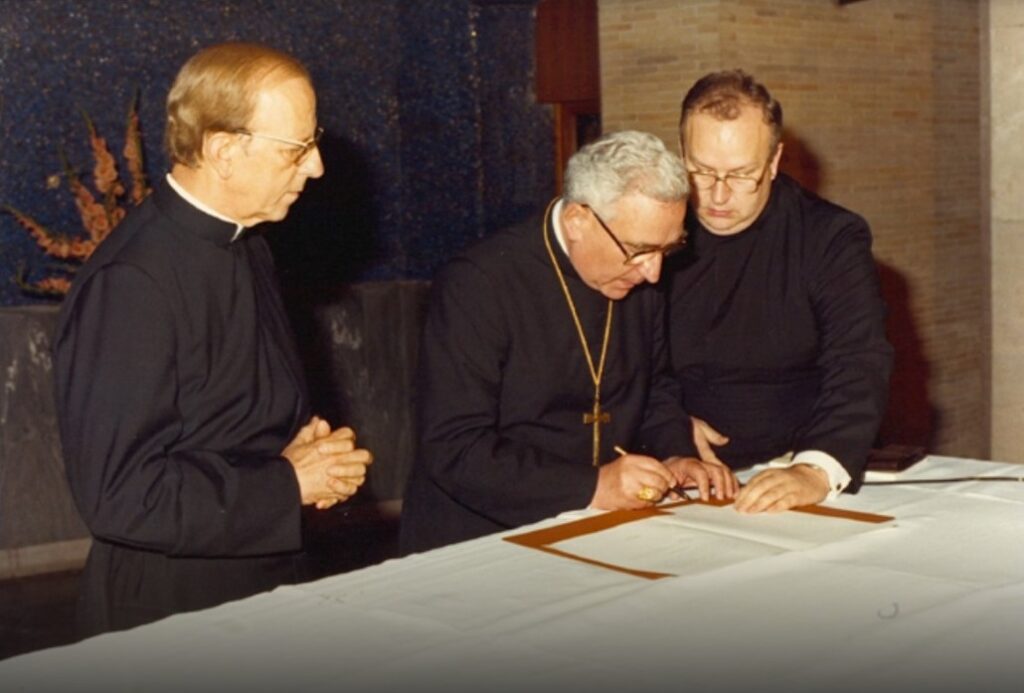
He does so while being the prefect of the Dicastery for the Laity, Family and Life. From that position Farrell plays a major role on how the Vatican deals with lay movements so far sparred from scandals of sexual abuse, and who play a key role in Rome’s formal and informal peace efforts in places such as Ukraine and the Middle East, such as the Sant’ Egidio Community.
However, it also has authority over others affected by many of the same issues one finds in the Legion of Christ or the Sodalitium, such as the Emmanuel, which was the subject of a previous installment in this series, linked after this paragraph, that prove how easy is for the movements under Farrell’s authority to fall for many of the same traps shaping the sexual abuse crisis in the Catholic Church.
If one goes deeper into Farrell’s biography one finds he played a key role in the Legion during his time in Monterrey, Mexico. He was one of Maciel’s Irish recruits. As his brother Brian Farrell, the now emeritus secretary of the Dicastery for Promoting Christian Unity, Kevin Farrell was the embodiment of the blonde, fair-skinned, Native English-speaker priest, Maciel loved to use to seek donations from wealthy Whitexicans, delighted to support Maciel’s brand of Catholicism.
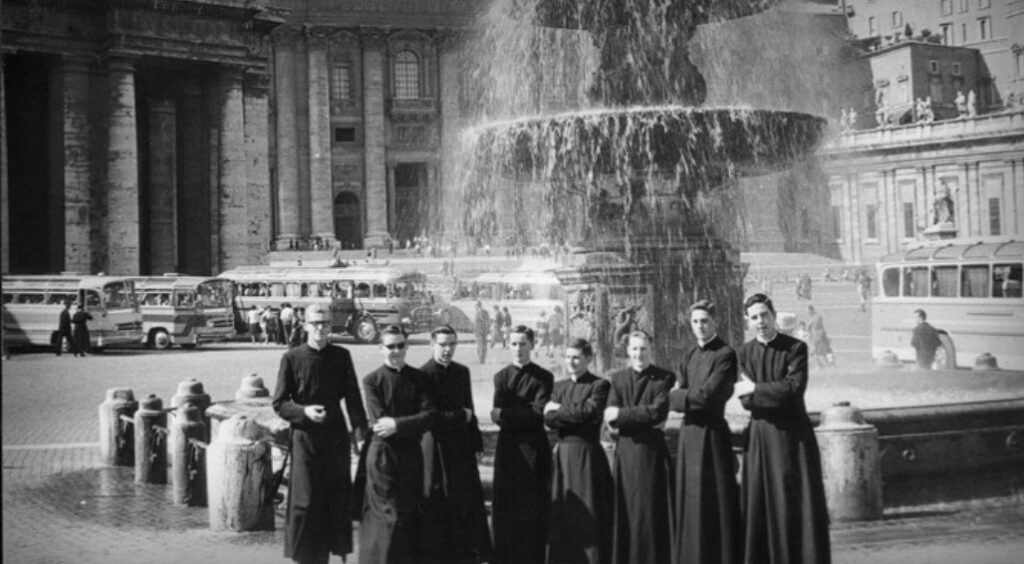
He left Monterrey, Mexico, and the Legion of Christ, when he decided to join the archdioceses of Washington, D.C., as a diocesan priest in 1984, during James Aloysius Hickey‘s tenure as archbishop there.
In the first year of this century, after John Paul II‘s decision to promote noted predator Theodore McCarrick to that diocese, Farrell became his auxiliary. One year after McCarrick’s resignation, in 2007, Benedict XVI appointed Farrell as bishop of Dallas, Texas. By 2016, with Francis having a fraught relationship with the United States Conference of Catholic Bishops, the Argentine Pontiff brought Farrell to Rome as head of his current assignment.
Managing, not solving the crisis
At this point it is impossible to dismiss yet another issue when going over how the Catholic Church at large has been unwilling to actually confront Marcial Maciel’s legacy. On the one hand, it is clear that the Apostolic Visitation to the Legion of Christ never actually addressed the root causes of the large-scale abuse there.
The language used in the official 2010 communiqué confirms the Vatican’s willingness to manage, rather than condemn, the crisis, as it was, for the most part, the standard operating procedure of the Roman Curia during the pontificates of both John Paul II and Benedict XVI.
On top of that limitation as noted before, on this piece I am using a translation of my own of the Spanish-language communiqué issued after the end of the Apostolic Visitation to the Legion of Christ. Even if originally the statement was issued in Spanish, Italian, and English, at some point in previous years, the Italian and English versions disappeared from the www.vatican.va domain.
Nowadays the only revery of the English-language official translation exists in a forgotten corner of the Catholic Culture website or in its corresponding “witness” at Internet Archive. Any other link to the English version of the statement is lost in the wilderness of the Internet.
And even if both versions are similar, one must note the small details in the English-language translation. While the original Spanish text labels Maciel’s actions as “comportamientos gravísimos” (extremely grave) and stated he built a systematic defense of “coartadas” (the plural of the Spanish word for alibi), the official English translation softened these facts. It downgraded the findings to merely “serious” and, crucially, reduced the complex network of lies and cover-ups to just “an alibi,” in the singular.
By softening the language, the English-language version seems to try to avoid presenting the crisis as one of overwhelming institutional magnitude, keeping a narrative centered around one evil individual, more manageable for PR purposes. These linguistic decisions force one to wonder why the need to soften the already soft language in the Spanish-language statement.
And it is not a minor issue, a linguistic curiosity. After Mexico, perhaps more than Spain or Rome, the U.S. is a key space to understand the expansion and development of the Legion, without losing sight of the fact that is there where both the chances to actually sue and the ability of the survivors to organize themselves are notably superiors than what one finds in the Spanish-speaking world.
Taken together it is hard to not find in these decisions an attempt, 15 years after an inconclusive Apostolic Visitation, to keep the fiction of Maciel as the “abominable lone predator.”
Lagging Behind
Given the institutional failures and reliance on foreign justice, Mexico lacks the kind of tools and political will to address religion-based violence, sexual and otherwise that one finds in the United States or France.
There has been no attempt of the Mexican conference of bishops to commission or develop a probe as systematic as the French Sauvé Report. Similarly, there is no memory in Mexico of at least an attempt to call the equivalent of the Royal Commission on sexual abuse in religious institutions in Australia.
Even if there was the political will to pursue something similar, human rights violations are so common in the country, many of them perpetrated by the government or its agents, that it would be hard to justify why clergy sexual abuse should be addressed before the Dante-like figure of more than 100 thousand persons “disappeared” over the last 60 years of so in the country.
Even more limited attempts, as the hearings by a select committee in the French National Assembly prompted by the violence at the Catholic school in Bétharram are unconceivable in Mexico.
The same could be said about the response from the Mexican authorities in cases of sexual violence in public schools. On Friday, November 28, French medium Franceinfo published a piece about how a male professor at a High School (Lycée) in Marne was able to weave a network of complicity and impunity operating from 1997 through 2021. It was up to a fellow female professor, Marie-Pierre Jacquard, to denounce him (opens content in French).
In Mexico there is a similar case at a college in Oaxaca where a female professor, Virginia Illescas, at great personal risk, uncovered a network of sexual abuse at the college.
Even if Jacquard faced rejection and push back, eventually her voice was heard, and she remains a professor at the High School. Virigina Illescas was not that lucky.
Although the Mexican authorities formally acknowledged the abuse of students at the college in Oaxaca, Illescas was fired and ultimately punished for protecting her students. The story, linked after this paragraph, available only in Spanish, goes into greater details of her case.
And unlike the national reckoning that came after alumni from Bétharram, and other Catholic schools revealed the extent of the abuse at their halls, it is hard to imagine the alumni of Catholic Mexican schools setting the scenario for a similar national acknowledgment. After all, having access to a Catholic school in Mexico is, for the most part, a symbol of status, of privilege, and it is hard to imagine someone giving up his or her status in Mexico.
One only needs to read yet another report from France to figure out the powerful impact of Bétharram in other victims of abuse, sexual or otherwise. In the same French region where the school in Marne is, there was another case, also at a High School, where a student and victim of abuse told French media (opens content in French) about the impact Bétharram had in her decision to come forward:
- The Bétharram case affected me deeply. Then I came across an article about the Bayen case. I realized, from the testimonies given by the young people, that it was the same modus operandi as my abuser. Then I read the testimony of Marie-Pierre Jacquard… In my case, there was also someone who wanted to report his actions to the regional education authority. She was subjected to the same pressure as Marie-Pierre. This woman had managed to gather enough information to come forward. I contacted Marie-Pierre, and I felt it was time to speak out.
Perhaps more important, there is no Mexican equivalent of the effects of Dominique Pelicot’s trial. Due to Gisèle Pelicot’s pressure, Dominique’s and his more than 50 accomplices’ trial was public, breaking with French tradition, but following her idea of “shame changing sides” (la honte change de camp).
The justice that was achieved by Aguilar Rivera’s Mexican survivors in California, while essential and restoring for those individuals, was ultimately imported to their country, and only apprehended through the lens of the virtues of the United States system of justice.
If the Mexican public opinion has learnt something is that the better chance at achieving a measure of justice is if there is a U.S. judge willing to bring the case to his or her jurisdiction which is, for practical purposes, a self-defeating proposition as it entails an extremely complex and expensive operation.
More relevantly, those brave fights fought in courts in the United States are unable to build the necessary critical mass in Mexico to drive domestic legislative change. Not even to put pressure on the state attorneys’ offices to pursue similar cases in Mexico. Suffice to watch how neither the State Attorneys’ offices in Jalisco, the State of Mexico, or Baja California, the Mexican states with the largest populations of Luz del Mundo members, nor the Nation Attorney’s Office aim at similar trials for the Mexican branch of that church.
Beyond the wall
Back in 2021, before the ruling on Naasón Joaquín García in California, a single member of the Mexican Lower House, then congresswoman Adriana Dávila Fernández requested a report from the Mexican Executive branch regarding their collaboration with the United States government on the abuses in the Luz del Mundo Church in Mexico.
Her speech is available here (opens a PDF in Spanish), and as good as it is to highlight the reasons to pursue in Mexico a similar probe to the one pursued by the California State Attorney’s office, nothing happened in the Congress or elsewhere in Mexico.
Mexican reality stands in sharp contrast to the concerted, high-profile movements seen in France, Germany, and the U.S., where victim groups, supported by media and a wide array of non-profits constantly put pressure on national and subnational governments to develop systematic probes.
The advocacy landscape in Mexico remains fragmented by fear, social status, mutual distrust, and a perennial lack of will of political and religious institutions to actually acknowledge their own mistakes. Far from acknowledging mistakes, die-hard Catholics, members of the Luz del Mundo church, as much as the die-hards of any political party in the country, never accept a mistake of their own.
What results is a balkanized victim base unable to force the national dialogue leading to a potential reckoning similar to what has happened in other countries.
And as much as one could be willing to blame the government, it is important to acknowledge that the most effective and meaningful reckonings so far in the four decades of the clergy sexual abuse crisis have been the byproduct of the will of the religious, Catholic, elites to accept their own mistakes.
That has been the case of the John Jay College report commissioned by the United States Conference of Catholic Bishops, the “successful failure” of the German bishops to publish their own national report back in 2013, which was sabotaged by their own fear to acknowledge the depth of the crisis, but that ultimately has been the springboard for the current diocesan reports of which they published three this year as the story linked after this paragraph tells in the “German reports” section. Finally, there is the French Sauvé Report that still stands as the most ambitious and comprehensive reckoning of the extent of sexual abuse, paid by the French Catholic hierarchy.
Acknowledging their own mistakes
And in France it is not only at the level of the national conference of bishops. As recently as this Tuesday November 25, the bishop of Nevers, Grégoire François Bruno Drouot, at 49, the second youngest in France, when confronted with a new case of clergy sexual abuse in his diocese, 130 miles or 210 kilometers South of Paris, in central France, acknowledged past institutional failures.
This attention to historical cases is driven by judicial precedent. Weeks before Drouot’s statement, a French court in Val-de-Marne (near Paris) judged and condemned Jacques Delfosse, an 88-year-old priest with more than 50 accusations of sexual abuse, going back to the 1960s (opens content in French).
The case proved that even deeply buried historical abuse is now being actively prosecuted, probably prompting Drouot to take the lead and prevent the usual kerfuffle when old cases come back to discredit Catholic dioceses.
That day Drouot sent press releases to the local media to ask for testimonies of potential victims of what in Mexico and most Latin American countries would be dismissed as an “ancient” and dead case.
Cases such as that of already deceased priest Gaston Rouzeau, who was assigned to the parish of Saxi-Bourdon et Saint-Saulge from 1958 to 2005, would hardly be considered in Latin America. However, there is a chance of potential victims being alive, as with Delfosse’s victims, and Drouot, in that regard, acknowledges the need to call for their testimonies as to deal with the aftermath of Rouzeau’s abuse.
Recently, Mexico saw the emergence of a similar “old” case involving a deceased priest. The story linked after this paragraph goes over the details.
And in countries where the religious elites have no appetite for looking themselves at the mirror as to acknowledge their own mistakes, there is always a chance to convene something similar to the Australian Royal Commission, launched back in 2013 that went deep into Catholic, Anglican, and many other denominations’ cases, on top of systematic probes and analysis of what happened abuse wise in other institutional settings there.
One would wonder that given the Mexican political elites’ ideals of a “lay State,” their own PR parlance about a “strict” Church-State separation that should be the route to figure out a solution to the issue. Despite their ideals, the reality is that Church-State separation has been for the most part a rhetorical device, a dart used by political elites to attack each other without any real effects. Otherwise, there is no way to explain not only Catholic cases such as that of Maciel, but also the situation at the Luz del Mundo Church.
It also necessary to keep in mind that, in Mexico, the government is frequently behind many human rights violations.
Given these absences, it is more necessary to pay attention to what could come as a consequence of the bill recently introduced in Mexico. On the one hand, it should be clear that there is no actual debate about the future of the bill. The ruling party has enough seats in both houses of the National Congress to expect a relatively smooth approval process. But that is also why it is necessary to pay attention to the potential failures of the proposed bill.
On the one hand, the bill, available here only in Spanish is more precise as to define what sexual abuse is and who could face heightened punishment if found guilty of doing it, but Mexican law, as much as most of other Latin American countries, lag behind their European and North American counterparts on key issues.
A main issue if the pressing issue of reparations. Reparations are a critical issue in Mexico as proven by the Supreme Court resolution of November 18 to reject an habeas corpus aimed at restoring the Mexican government’s duty to allocate money to compensate victims of crime. The draft resolution on the habeas corpus is available here in Spanish although it was rejected by a majority of votes.
Given the Supreme Court’s resolution, one has to wonder if preventing a national reckoning when dealing with sexual abuse in religious organizations helps the Mexican elites to avoid addressing their own mistreatment of victims of abuses from the Armed Forces and police, and other governmental institutions.
It is as if, by making the prospect of reparations from the religious institutions a distant goal, the government itself was protecting its own interests when dealing with human rights’ abuse.
Another key issue to keep under watch is whether or not there will be changes to the current law on the issue of reporting. As of today, Mexican law calls for “immediate reporting” of abuse but fails to clarify the consequences for individuals or institutions that withhold information, leaving the most critical mechanism for enforcement ambiguous and toothless.
If the reform about to be introduced in the Mexican congress is for real, then it should state as clearly as possible how many hours should pass from discovery or knowledge to reporting a case of abuse to the relevant authorities, but also clearly state the consequences for both the individuals and the institutions involved in such cases.
A story from the border
Early on Friday November 28, the diocese of Piedras Negras in the Mexican state of Coahuila, published a statement about a sexual abuse case involving that diocese and that of Laredo, Texas.
Unlike the French diocese of Nevers decision to publish the full name of the now deceased priest, Mexican dioceses, following Mexican law, avoid publishing the full name of priests accused of abuse.
Still, the diocese of Piedras Negras showed a measure of transparency by acknowledging the issue and providing a partial name for the alleged predator.
The card featuring the partial name without the customary full surnames used in Spanish, appears before this paragraph and is available on their Facebook account here.
A simple search of their Facebook account returns only one priest with that name: Luis Efraín Mares Muñoz. There are two matches from 2018, the most recent being a card congratulating him on his ordination anniversary, available as an image after this paragraph.
For some unknown reason, the website of the diocese of Laredo, Texas, has been offline, and their Facebook account returns no match for Mares Muñoz.
Archived “witnesses” of that diocese’s website via the Internet Archive returned no matches. Therefore, Mares Muñoz’s whereabouts are unclear at this time. However, there is no reason to dismiss the diocese of Piedras Negras’ report.
The case happened 18 years ago, in 2007, in Piedras Negras, Mexico, Eagle Pass, Texas border sister city. It involves a male who was underage then.
It is also unclear at this point if there are any standing reports regarding Mares Muñoz in Laredo. All that is known so far is that bishop James Anthony Tamayo of Laredo set restrictions on Mares Muñoz’s ministry for the time being.
The last available digital trace of his time in Piedras Negras is a video where he says good bye to the parish of the Sacred Heart of Jesus, available after this paragraph with audio only in Spanish and here. The video was uploaded on January 6, 2019.
There are unconfirmed reports of Mares Muñoz becoming a U.S. citizen. Some sources claim he was, during a brief period, commissioned to the Mexican diocese of Nuevo Laredo, but there is no digital trace of him in the Facebook page of that diocese. Finally, late on Friday it was known that he is not in active ministry at the diocese of Laredo, Texas.
Mares Muñoz’s case could involve at least one more diocese. Piedras Negras is a relatively new entity in Mexico, having been created by Pope John Paul II in 2003 from the territory of the diocese of Saltillo, Coahuila’s capital. Mares Muñoz was originally ordained as a priest of Saltillo in 1996.
If the Mexican Catholic hierarchy is willing to learn the ways of transparency and accountability, this is a great chance to do so by going deeper into Mares Muñoz’s record at the Saltillo seminary and as young priest, his tenure at Piedras Negras, and more recently, on the other side of the border, his time in Laredo, Texas.
Post Data
On other issues it is necessary to keep track of what has happened recently in the archdiocese of Tijuana, Mexico, and that of Cádiz, Spain. Both have been the focus of previous installments of this series.
As far as Cádiz is concerned, the appointment of the auxiliary bishop of Seville, Ramón Darío Valdivia Jiménez, as the apostolic administrator after Rafael Zornoza Boy’s “troubled” departure.
Troubled only in the sense that he had to confront the media storm after news of how he abused an underage male when he was a priest in the diocese of Getafe in Madrid’s metro area.
The story linked after this paragraph went into more details regarding Sornoza and why it was a “safe risk” for the Vatican to put some pressure on the bishops of Spain to actually come to terms with their own history of clergy sexual abuse.
Something similar has happened in the archdiocese of Tijuana, the largest metropolitan area in Baja California, Mexico. However, the appointment of an Apostolic Administrator there came after the sudden death, on October 26, of Francisco Moreno Barrón.
That archdiocese has had a handful of cases of clergy sexual abuse. From 2011 through 2014, a flurry of reports emerged in local media in both Tijuana and San Diego about the scale of abuse there.
Ultimately, a few months after Pope Francis’s election, back in 2014 there were some rather limited “disciplinary measures,” with little or no consequences. The accused then were Jeffrey David Newell; Enrique Tenorio Pérez; Aurelio Castillo Aguilar; Carlos Castillo and Danilo Pietro Zanini.
The next year, another priest would end in jail but not because Raymundo Figueroa Pérez was accused of sexual abuse, but because he led a rebellion of sorts to take full control of a church under his care.
Then bishop and current emeritus Rafael Romo Muñoz, mobilized the archdiocese’s resources to force out Figueroa Pérez and retake the parish of the Blessed Sacrament (Santísimo Sacramento) in Rosarito, near Tijuana.
Romo Muñoz also allowed the growth of what is now a full schism in Tijuana led by Isidoro Puente Ochoa, who is part of the legacy as bishop of Tijuana of Emilio Berlié Belaunzarán, who promoted his to Monsignor, an honorary title that in the Spanish-speaking Catholic world is not exclusive of bishops and Cardinals. Years later, bishop Rafael Romo Muñoz (1996-2016), approved the foundation of a female religious order and, later, in unclear circumstances, a seminary which, unlike the diocesan seminary of Tijuana, was willing to receive underage males.
Ultimately, after a protracted conflict, Rome decided to shut-down Puente Ochoa’s seminary. For the most part, seminaries nowadays prefer to receive adult males. Seminaries that accept minors are relics from a not-so-distant past because, to nobody’s surprise, they are often affected by abuse of the students. The decision to close the seminary was immediately challenged by Puente Ochoa who decided to join a schismatic movement.
It was hard to expect a different outcome given how Puente Ochoa uses a YouTube channel to go over the usual set of talking points of Catholic Traditionalists. Repeatedly he criticized there both archbishop Moreno Barrón and Pope Francis, until Rome cancelled the seminary’s accreditation.
As it is usually the case in the Catholic Traditionalist movements, in some of his videos he rallies against all recent Popes, perhaps with the exception of Pius X, Pontiff from 1903 through 1914, and a hero of those movements.
When back in September 2024 the exchange between Puente Ochoa and Moreno Barrón reached a peak they had a public confrontation over doctrine and practice. Ultimately Puente Ochoa, early this year decided, to break with Moreno Barrón, but not with Rome. He goes to try to explain that approach in the video linked after this paragraph.
After Moreno Barrón’s death, Pope Leo XIV appointed Mario Nicolás Villanueva Arellano, the until then auxiliary bishop, as the Apostolic Administrator. It is unclear for how long.
Even if formally the Apostolic Administrator has power to rule on simple matters, unlike a full bishop, he must seek approval from Rome on any major decision.
Last time something similar happened in Mexico was in the archdiocese of Tuxtla Gutiérrez after the death of archbishop Fabio Martínez Casillas who died in November 2023 and also had an awful record when dealing with clergy sexual abuse cases there. So much, he was among the 15 bishops included in the short piece linked after this paragraph.
The appointment of a new archbishop there took more than a year, until April 2025, so given the record of issues in Tijuana during Romo Muñoz’s and Moreno Barrón’s tenures it should not come as a surprise if there is a similar period of a so-called sede vacante in Tijuana, the period where there is no bishop in the diocese.
The appointment of an Apostolic Administrator in Tijuana is not merely a bureaucratic delay; it is a model Pope Leo XIV went through when he originally took over the Peruvian diocese of Chiclayo, in November 2014.
Pope Francis only appointed him as bishop there almost one year after, in September 2015. It is hard to guess what is behind the decision made in Tijuana, but the situation there is dire, as the story linked after this paragraph explains, and because Tijuana is one of the Mexican archdioceses unwilling to acknowledge Pope Francis’s 2019 instruction to set up a commission to prevent sexual abuse.
Final note: The main illustration includes a background taken from Sandro Botticelli’s Inferno, Canto XVIII, available at Wikimedia, and three of the pictures used over the piece. The credits appear with the corresponding picture. The audio summary of the piece uses Public Domain music: J.S. Bach’s Air On The G String (from Orchestral Suite No. 3, BWV 1068), recorded by the United States Air Force Band.