
MADRID (SPAIN)
Omnes [El Paso, TX]
March 30, 2026
By Javier García Herrería
The new protocol does not develop one of the points of agreement signed last January, in which the government committed to investigate sexual abuse in all areas of civilian life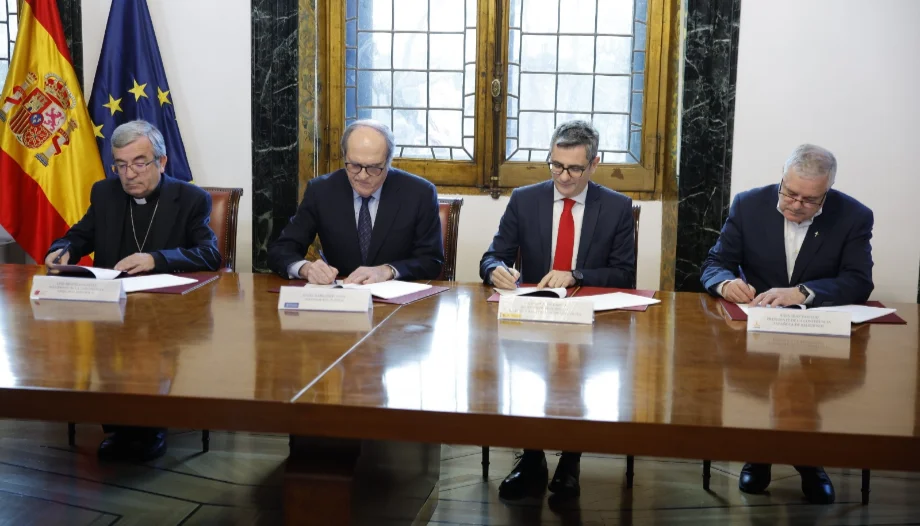
@Ombudsman
In a move described as a «historic moral commitment», the Spanish Church, the Government and the Ombudsman have sealed on the morning of March 30, 2026, the definitive protocol for the comprehensive reparation of victims of sexual abuse in the ecclesiastical sphere.
This agreement builds on the pact reached last January 8th and sets in motion an unprecedented institutional mechanism for the state to monitor the adequacy of the claims handled by the PRIVA plan (the Church’s reparations plan). It will also allow victims to go directly to the new platform created by the government to process their claims against the Church.
The government’s position
The new agreement does not develop the first point of the agreement signed last January, in which it was assured that the government would address «the comprehensive reparation of victims of abuse in any area of social life”. This exclusion from the basis of the original agreement means, in practice, renouncing a comprehensive and cross-cutting response that would have given this step a fully historic character for all victims.
During the press conference following the signing, when asked about the extension of these measures to all those affected, the Minister of the Presidency, Felix Bolaños, affirmed that the document signed today strictly adheres to the road map established last January 8. However, this declaration eludes the first point of that original commitment, in which the Government expressly obliged itself to address the integral reparation of the victims of abuses in “any area of social life”.
Forgetting the Ombudsman’s recommendations
After signing the agreement, Bolaños stressed that the new protocol complies with the central recommendation of the Ombudsman’s report of 2023, which urged the public authorities to establish a reparation plan under an institutional guardianship independent of the Church. The minister welcomed the fact that, through this system, it will be the State that guarantees an objective and professional assessment of the damage suffered by the victims.
However, the executive has avoided pronouncing on another of the key recommendations of this investigation: the need for reparation and prevention measures not to be limited exclusively to the ecclesiastical sphere.
For his part, Ángel Gabilondo reiterated his wish that studies and avenues of reparation be addressed in the future in other social contexts in the same way that has been initiated today with the Church. However, the Ombudsman has not specified deadlines or timetables for the implementation of this universal response, which his own report described as a reparation obligation of the State.
What is new compared to the previous situation?
Until today, the Church operated mainly through PRIVA (Plan de Reparación Integral a Víctimas de Abusos), an internal system that since February 2025 has handled 131 applications.
The great novelty of this protocol lies in the fact that victims who wish to do so will be able to manage their claims directly through the state and, in addition, the state will supervise the resolutions of the PRIVA plan. It is no longer only the Church that evaluates and proposes reparations; now a team of independent experts comes into play under the umbrella of the Ombudsman, who will have the last word in case of discrepancies.
Another important novelty is that the Government has shielded the compensation, so that the money received by the victims will not be taxed in the IRPF, ensuring that the reparation reaches those who suffered the damage in full.
New protocol
- A single state window is created so that the victim does not have to go to the ecclesiastical structure if he/she does not wish to do so. On the one hand, the Ministry of the Presidency, Justice and Relations with the Courts will create a «Processing Unit» that will receive the applications, offer guidance for the presentation of the same and will take care of the communication with the parties, the notification of the proposals and the collection of the necessary reports. The deadline for submission of applications opens in two weeks, on April 15.
- On the other hand, the Ombudsman will set up the «Victims Unit», which will be in charge of carrying out -with a team of independent professional experts- the individualized evaluation of the applications.
- For the first time, in case of disagreement between the Church and the evaluators on a case, the Episcopal Conference and the Confederation of Religious will be in charge, through the PRIVA advisory commission, of issuing a report on each of the assessments of recognition of victim status and reparation formulated by the Victims Unit of the Ombudsman.
- In case of discrepancy, a mixed commission will study the case, which will ultimately be established by the Ombudsman after hearing the president of the EEC or CONFER, as the case may be. As Minister Bolaños pointed out in the aforementioned press conference, “the last word on reparations will be left to the state”.
Types of Repairs
The document signed this morning offers three dimensions for comprehensive healing. On the one hand, symbolic reparation, focused on acts of public and institutional recognition that validate the testimony of the victims and dignify their memory. It will also offer human and spiritual accompaniment, including formal requests for forgiveness and access to specialized treatment to address the physical and psychological sequelae of abuse.
Finally, it also establishes the economic reparation, which will be determined on an individualized basis, taking as a criterion the seriousness of the facts and the impact of the damage caused in the survivor’s life.
This mechanism will be in effect for an initial period of one year, with the possibility of being extended for an identical period.