
NEW ORLEANS (LA)
The Guardian [London, England]
June 15, 2026
By Ramon Antonio Vargas
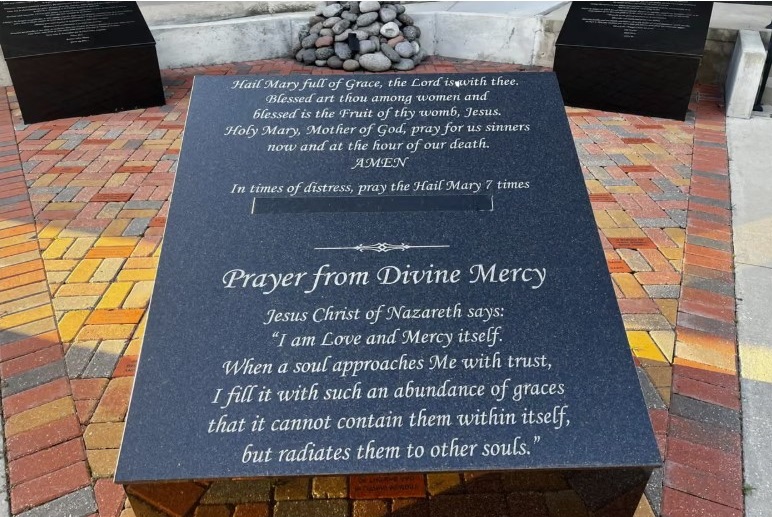
[Photo above: Black tape covers Anthony Odiong’s name on a prayer inscription outside a chapel he helped build in Luling, Louisiana, in his role as a Roman Catholic priest. Photograph: Ramon Antonio Vargas]
Church officials had extended the temporary term of Anthony Odiong, recently convicted of sexual assault, even after women came forward with allegations of abuse
Internal Catholic church files obtained by the Guardian reveal that clergy leaders wanted to quadruple what was supposed to be a temporary, three-year role as pastor at a suburban New Orleans church for a priest who had nearly a half-dozen women accusing him of sexual misconduct or unwanted advances while ministering to them.
Anthony Odiong was supposed to be at the St Anthony of Padua church in Luling, Louisiana, from 2015 to 2018 when – toward the end of that time frame – his supervisors extended his stint by three years despite a series of misconduct complaints, including one that ultimately sent him to prison for life in June.
By 2021, his superiors moved to prolong his stint another six years, until 2027 – despite having spoken to a woman who had come forward to accuse Odiong of an abusive, years-long sexual relationship. She was at least the fifth female congregant who had claimed enduring misconduct by Odiong after meeting him in his capacity as a priest.
“You have served … with fidelity and dedication,” New Orleans’ archbishop at the time, Gregory Aymond, wrote to Odiong while affording him that six-year extension. “Thank you for … the faithful way in which you continue to carry out the ministry of Jesus Christ today.”
Despite Catholic priests’ promise of sexual celibacy, Odiong subsequently fathered a child with a sixth woman whom he met through his clerical work. Only after all that did civil law enforcement – not church – authorities in Waco, Texas, where Odiong also previously ministered, finally hold him to account by convicting him of criminal clergy sexual abuse.
That shocking chain of events is laid out in more than 200 pages of in-house church documents reviewed by the Guardian after a Waco jury found him guilty of first- and second-degree sexual assault on 29 May. That same jury sentenced him to life imprisonment four days later.
As a whole, the documents divulge that Catholic church leaders for a region including Waco had received a significant number of misconduct complaints against Odiong while he was still in the middle of working there from 2006 to 2012.
Those Austin, Texas, diocese officials then confidentially notified their counterparts in New Orleans about the complaints in September 2018, three years after he began working under church leaders in that area.
Church officials in New Orleans not only went on to leave Odiong in place among their ranks for more than five years. They also represented to their colleagues in locales where Odiong traveled domestically and internationally during his ministry that he was “a person of good moral character and reputation”.
Odiong was only removed by the New Orleans officials in connection with the various complaints against him when he also made comments from his pulpit dehumanizing LGBTQ+ people – mere months before his arrest by the Texas authorities who would later convict him.
The documents afford the public its most complete look yet at exactly what church officials knew about Odiong – and when.
Furthermore, the records raise serious questions about whether officials whose church has spent years navigating clergy abuse scandals worldwide did all they could to safeguard those whom Odiong encountered through his work.
It is clear from the paper trail that Odiong’s supervisors waited years to prohibit him from continuing his ministry – and alert community members that they did so – under anti-clergy abuse policies long in effect because his accusers were not minors.
And it is plain to see that church officials did not believe the women met their criteria for vulnerable adults, which strictly speaking would involve their having severe intellectual, developmental or psychological disabilities.
In a statement, a spokesperson for the Austin diocese said it denies having “concealed information”, as victims contend the organization did. The spokesperson alluded to how the Austin diocese provided a letter to the New Orleans archdiocese about Odiong – and then publicly addressed the matter after the second of the organizations proclaimed it had suspended the priest from ministry.
“The diocese sincerely regrets that an ordained priest working in the diocese caused harm to the victims,” the Austin spokesperson also said.
A separate statement from the New Orleans archdiocese noted Aymond retired in February. The organization said had the previous “archdiocesan leadership … known of the extent and predatory pattern of Odiong’s behaviors, certainly different actions would have been taken”.
It added: “We are disgusted by Odiong’s behavior revealed during his trial, and what he was convicted of is reprehensible. We are sorry for the suffering these women and their families experienced, and our prayers are with those who have been hurt by his actions.”
The Guardian has reached out to Catholic church leaders in Odiong’s native Nigeria for comment.
‘You look hot’
Odiong spent the first 13 years of his career as a priest in Nigeria, where he was ordained within the Catholic diocese of Uyo in 1993.
In 2006, while Aymond was in a previous role as bishop of Austin, Odiong gained an assignment to serve as the associate pastor of St Mary’s Church of the Assumption in West, Texas, outside Waco.
The naturalized US citizen added a part-time role at the St Peter Catholic student center, which ministers to Waco’s Baylor University, in 2007, according to a curriculum vitae included in the records obtained by the Guardian. By 2008, that role at St Peter had become a full-time one alongside his post in West.
By all accounts, Odiong won over his Texas congregants with a charismatic persona and stated affection for the Virgin Mary.
But no more than two years into his full-time presence at Baylor, clear signs of concern began to emerge.
A woman told Austin’s diocese in 2010 that Odiong “bit her ear while he was giving her a hug on a sofa” at St Peter, where she worked, church officials there would later report. She also accused Odiong of having “hugged her by lifting her up by her bottom” and holding her there for a protracted amount of time.
“Odiong admitted hugging her in such a way” when confronted about it, but insisted that he did not mean for the embrace “to be offensive”, according to Austin officials.
He claimed to not remember biting her ear – or that the woman voiced “any complaint to him”, those officials also wrote.
In 2011, a student at St Peter came forward and accused Odiong of having spoken to her in “suggestive ways (eg, ‘you’re hot, you look pretty’)” and having “hugged her with long and inappropriate embraces that made her feel uncomfortable”, Austin diocesan officials would later report.
They reported that she also described how Odiong “placed his hand on her knee and thigh when in a private conversation with her”. But they were also sure to note that Odiong denied the allegations and “did not remember saying such things to her”.
The complaint that preceded the end of Odiong’s stints at St Mary’s and St Peter came that same year. A teenage boy had told officials that he had caught his mother, who was a Baylor employee, and Odiong – their priest – having sex in her bedroom after a family party.
It ultimately emerged at Odiong’s criminal trial that the boy later retracted his complaint because he feared his mother could be fired from her job over a Baylor policy requiring employees to conduct themselves in a manner that was consistent with Christian values. And the boy was keenly aware that his mother had primary custody of him and his six siblings after a tumultuous divorce from his father.
The documents reviewed by the Guardian showed the Austin diocese concluded that the boy’s complaint was “false” after his retraction. Nonetheless, the diocese’s vicar general, essentially its second-in-command, determined Odiong’s actions in the matter had been “highly imprudent”, the documents said.
The documents explained that then vicar general Michael Sis – who has been the bishop of San Angelo, Texas, since 2013 – arrived at that determination because Odiong had been “alone with the young man’s mother in her home, late at night, in a room with a small sofa and a bed, after a party had concluded”.
At least that is how then Austin bishop Joe Vásquez, now the archbishop of Houston, would eventually characterize Sis’s thought process in a missive to Aymond years later, after the latter had become the Catholic church’s prelate in New Orleans.
Austin church officials say Odiong left their diocese in 2012. His CV establishes that he was then outside the US for three years.
The CV lists Odiong spending that period pursuing a doctorate degree in dogmatic theology at the Pontifical University of St Thomas Aquinas, or the Angelicum, in the center of Rome, less than three miles from the Catholic church’s global headquarters at the Vatican.
‘Look forward to reconnecting’
Aymond was in his fifth year as New Orleans’ archbishop when he received an email from Odiong in October 2014.
Odiong requested that Aymond appoint him as the “pastor of a small [church]” and allow him to teach a class in theology at Notre Dame Seminary, the New Orleans college which trains Catholic priests. In the meantime, Odiong would complete “research work” for his dogmatic theology doctorate degree, he wrote.
“I am pleased to respond affirmatively to your request to serve in the archdiocese of New Orleans for a term of three years” beginning in the second half of 2015, Aymond replied in a message that mentioned he and Odiong had recently visited.
“I remember, with great fondness, our work together in Austin and I look forward to reconnecting with you.”
Before he could formally welcome Odiong to a second US diocese, though, Aymond told the priest to get a letter from his “local bishop” confirming he was in “good standing” and had permission to minister in New Orleans.
Records demonstrate that Odiong then obtained a letter from the bishop in Uyo, Nigeria, John Ebebe Ayah, declaring him to be “in good standing with the church”. Odiong, Ayah wrote, had “permission to take up pastoral assignment” from Aymond.
“I want to personally thank you for accepting him in your archdiocese,” Ayah wrote to Aymond, who assigned Odiong to Luling’s St Anthony of Padua to succeed a pastor grappling with health problems. “I pray the good Lord Jesus Christ continues to strengthen you in serving his people.”
At St Anthony, Odiong again proved himself to be popular, amassing a following through holding prayer services after which some in attendance reported healing from major ailments.
A visible token of the esteem that Odiong’s congregants had for him was a healing chapel commemorating the Virgin Mary for which he raised about $600,000 to build next to St Anthony.
Aymond in late 2016 wrote of visiting St Anthony while Odiong was elsewhere that day – and the archbishop said parishioners lavished praise on their pastor.
“So many said, ‘He cannot leave us,’” Aymond wrote.
Lauding Odiong’s time in Austin and his “excellent ministry there”, Aymond added: “I thank you for being in our archdiocese and the opportunity to work with you and to call you friend.”
St Anthony congregants by early 2017 had also written to New Orleans’ archdiocese to “express our increased happiness and enthusiasm with … Fr Anthony”.
“He has provided a heart, a soul and certainly an unending amount of love to our small yet robust community,” that letter said. “He has become the blood that quite honestly keeps us going and yearning for more.”
But despite that effusiveness, his past was about to start catching up with him.
In January 2018, Catholic church officials in Austin received a written complaint about Odiong from a woman who had not previously come forward.
She wrote about how she met the priest when she was a Baylor student and he was ministering there – and how he “inappropriately held [and] kissed her hand, and embraced her” after telling him she was thinking about becoming a nun.
Eventually referred to in legal proceedings as Miriam Doe, she testified in court that she could feel Odiong had an erection while holding her. It all dissuaded her from exploring a vocation as a nun.
The Austin diocese forwarded that woman’s letter to the New Orleans archdiocese. The New Orleans archdiocese’s executive director of clergy, Patrick Williams, wrote to Odiong to advise him about the complaint – but emphasized “there are no plans for follow-up on our part”.
“I know there is another perspective on these incidents from your point of view,” Williams continued. He also said it was not necessary for Odiong to contact the complainant “for that may cause further confusion”.
‘Refrain from engaging in ministry’
Austin church officials said Odiong needed “proper permission” to “engage in priestly ministry in the diocese” when he left in 2012.
That requirement did not stop Odiong from routinely traveling back to his old stomping grounds in and around Waco after his departure, including as a celebrant for several funerals.
Notably, seven months after the January 2018 complaint, the New Orleans archdiocese issued to Vásquez a letter of good standing on behalf of Odiong giving him permission to attend a festival in West, Texas, and the dedication of a sports complex there in his role as a priest.
Then, on 21 September 2018, Vásquez sent a letter to Aymond. It contained a summary of Odiong’s history of complaints from female congregants within the diocese of Austin up to that point.
One of the letter’s two carbon-copy recipients was Vásquez’s eventual successor as Austin bishop, Daniel Garcia. The other was the Austin diocese’s chancellor, a deacon named Ron Walker, who had served there under the leaderships of both Aymond and Vásquez.
Vásquez’s missive seemingly referred to those complaints as “the current situation and past notices of concern brought to our attention regarding [him] when he was present in the Diocese of Austin”.
And, citing those complaints, Vásquez told Aymond that he was “compelled” to request that Odiong “refrain from engaging in ministry in this diocese”, even if invited by Texas parishioners.
Williams, Aymond’s executive director of clergy, wrote to the Austin diocese in October 2018 that he had shared the “general contents” of Vásquez’s letter with Odiong. Odiong, Williams wrote, “would abide by the request of Bishop … Vásquez and not accept any invitations to engage in ministry in the Diocese of Austin”.
None of Odiong’s congregants, past or present, were notified about any of this. And, nearly two months after that September 2018 letter, Uyo bishop Ayah wrote to Aymond granting Odiong permission to remain at St Anthony another three years.
“I am deeply grateful to you,” Aymond wrote back to Ayah.
Saying he had a “great deal of respect for Odiong”, Aymond continued: “Fr Anthony is an outstanding priest. He has provided extraordinary ministry to the people of Luling … and beyond.”
‘No problems going forward’
On top of his work in Luling, Odiong in the coming years traveled to Israel; throughout Europe, including Rome; and across Louisiana, Texas and other parts of the US in the course of his ministry.
Typical letters of good standing from the New Orleans archdiocese authorized Odiong for weddings, religious pilgrimages and funerals, and in at least one instance for a baptism read: “He is a person of good moral character and reputation. I know nothing which would in any way limit or disqualify him from this ministry.”
The letters usually assured the recipients there was nothing in Odiong’s background “which would render him unsuitable to work with minor children” – and that he was up to date on so-called safe environment protocols meant to shield minors and vulnerable adults.
Yet complaints from Odiong’s past kept surging forth. In April 2019, a woman who would later be identified in court proceedings as Hadassah Doe called the New Orleans archdiocese to report having had a years-long sexual relationship after meeting him at Franciscan University in Steubenville, Ohio, in 2007.
Odiong had studied at Franciscan while he also ministered in Texas. An email sent under Odiong’s name at one point thanked Aymond for “paying for the greater part” of those studies at Franciscan, though the message didn’t elaborate any further.
The woman said Odiong initiated that relationship after first positioning himself as her spiritual counselor at Franciscan. The relationship then spanned Ohio; Pennsylvania, her home state at the time; Waco; and Luling, she said. She also said Odiong stole money from her. And she reported him, without ramification, to various law enforcement agencies.
An archdiocesan official who fielded that complaint jotted down a note in internal church records which said the woman seemed more focused on Odiong’s alleged “embezzlement” than on the purported sexual abuse. That, the official opined, was “telling”.
A sexual misconduct complaint from who by then was a fifth accuser yielded no substantial consequence for Odiong.
He finally drew harsher consternation on 6 September 2019. It was in the form of a letter from the Austin diocese after Odiong celebrated a mass at a festival in West and led the recitation of a rosary prayer at a funeral. Odiong did that despite Vásquez having said he wanted the priest to refrain from ministering within the Austin diocese a year earlier.
“I am confused that you would have so quickly disregarded … Bishop Vásquez’s wishes,” James Misko, who had also been an Austin vicar general, wrote.
Misko – now the bishop of Tucson, Arizona – moreover wrote that Odiong had even been reminded of what the bishop wanted when he called the diocese in advance of the trip and said he had been invited to West.
And Misko warned Odiong that “refusing to respect the letter or intention of Bishop Vásquez’s request may compel us to advise others of your restrictions, making this situation more public than you may wish”.
Carbon-copied on that rebuke were Aymond, Vásquez and Walker.
Odiong wrote back later that same month with profuse apologies. He said he did “not fully grasp the depth” of the clerical “restrictions … imposed on me by Bishop Vásquez” in and around West and Waco, claiming that the details of those limitations had only been communicated to him secondhand.
“I did not intentionally disregard Bishop Vásquez’s intention,” Odiong wrote. “Truth is, I did not understand the full implications … until reading your letter. And since I have a better understanding of the situation, we will have no problems going forward.”
Odiong would travel from Luling to the Waco-West area at least once more after that, though the purpose of that trip was described as a “weekend visiting friends,” according to correspondence reviewed by the Guardian.
At any rate, Aymond wrote to Odiong at the beginning of May 2021 to notify him that he was welcome to remain at St Anthony until at least 2027.
“Thank you for your willingness to continue as pastor,” Aymond wrote to Odiong.
A September 2021 letter attributed to Ayah and addressed to Aymond then said the Uyo bishop approved of keeping Odiong in the New Orleans archdiocese.
“Thank you for your fatherly care of him and for all the help you have extended to him so far,” that letter to Aymond said.
‘Concealment over disclosure’
Odiong’s path to prison started in earnest when he likened members of the LGBTQ+ community to “monkeys and chimpanzees” while delivering a homily to St Anthony congregants at a Sunday mass in November 2023.
The New Orleans archdiocese soon announced that it was suspending Odiong from ministering in the region encompassing St Anthony primarily over complaints of misconduct with multiple women, adding that the inflammatory, anti-LGBTQ+ comments did not help his cause.
The archdiocese said it had asked the bishop of Uyo to recall Odiong back to Nigeria. It omitted mentioning that more than five years had passed since the New Orleans archdiocese first received written notice about those misconduct complaints.
Hadassah Doe at that point publicly spoke to the Guardian and its reporting partner WWL Louisiana about her experience with Odiong.
Miriam Doe and a previously unknown accuser eventually referred to in court as Jane Doe then spoke to the Guardian for a February 2024 article to vouch for the credibility of Hadassah Doe’s account. In her case in particular, Jane Doe said Odiong convinced her to submit to a form of intercourse with another man to which she did not legally consent.
Odiong did that after positioning himself as Jane Doe’s spiritual counselor at St Peter in Waco, she recounted. And Texas considers that behavior from a religious cleric to be felony sexual assault.
Notably, Jane Doe at the time also revealed that Austin diocesan officials had just informed her that they had banned Odiong no later than 2019 from ministering in the Waco area over similar misconduct allegations. Those officials told Jane Doe that they alerted their New Orleans counterparts to that prohibition, too, albeit privately.
The woman whose son had seen her having sex with Odiong in 2011 then saw Jane Doe’s and Miriam Doe’s stories in the Guardian. Later given the pseudonym Mary Doe, she filed a sexual assault complaint against Odiong with Waco authorities in March 2024.
Investigators who went on to pore over years’ of Odiong’s digital communications secured cooperation from several additional accusers of his. Those included some from Odiong’s Texas days who had come forward to the church – and some from his time in Luling who until then had remained silent.
DNA evidence gathered by Waco authorities also established that Odiong had fathered a child in the spring of 2023 with a congregant to whom he provided religious counseling after meeting her in Luling.
Those authorities arrested and charged Odiong with first- and second-degree sexual assault within months of his suspension of ministry.
At one point they accused him of possessing digital images of disrobed children, but authorities never pursued formal charges for that allegation.
Prosecutors tried Odiong over four days at a state courthouse in downtown Waco beginning on 26 May.
After brief deliberations, jurors found him guilty of having sexually assaulted Mary Doe and Jane Doe – and then sentenced him to life imprisonment, though with a chance at parole after 30 years.
Odiong became the fifth New Orleans archdiocese clergyman to be convicted of or plead guilty to sexually violent crimes after the organization’s bankruptcy filing. His attorneys quickly indicated that he planned to pursue an appeal.
The 76-year-old Aymond’s age-mandated retirement as New Orleans’ archbishop took effect on 11 February, two months after his former archdiocese and its insurers in December agreed to pay $305m to hundreds of abuse survivors.
That agreement aimed to settle a bankruptcy protection case that the archdiocese filed amid the financial fallout of the worldwide Catholic church’s clergy abuse scandal, though individual survivor payouts might not start for months more.
The New Orleans archdiocese, now led by Aymond’s successor, James Checchio, said in a post-verdict statement: “What Odiong is convicted of is reprehensible, and we are disgusted by the behavior revealed in trial.”
In Austin, Bishop Garcia published a pastoral letter after Odiong’s sentencing seeking to assure parishioners that – among other things – prior information known to his diocese “did not indicate the level of criminality and egregious nature of the details revealed in court”.
Garcia acknowledged Odiong had not yet been ousted from the Catholic priesthood – but promised to “make the proper inquiries” about that process with the criminal case concluded.
He also said parishioners could rest easy knowing any sacraments they received from Odiong were valid regardless of his criminal conviction.
An Austin diocese spokesperson later said diocesan officials had invited victims to speak with church leaders “in a private setting through appropriate channels, including counsel”. The spokesperson also said the diocese has “deep sorrow that harm was caused to [victims] by Fr Odiong”.
Neither Jane Doe nor Mary Doe were impressed with the statements from the Austin diocese and Garcia.
“I am not asking [Garcia] to feel what I feel,” Jane Doe said in part in a lengthy statement. “I am asking him to say plainly what is true: that the diocese received credible reports, that it chose concealment over disclosure, that this choice left women unprotected and uninformed for years, and that no appeal to canonical process or jurisdictional complexity changes what that decision cost us.”
Jane Doe’s statement also bluntly asked: “Who in the diocese’s leadership is going to be held accountable for that, and when?”
As for Mary Doe, she said Odiong’s survivors deserved more than “blase vanilla statements” like the one from Garcia that stopped short of an actual apology to them.
“This ‘form letter’ minimizes the diocese of Austin’s role and continues the harm by placing a … vast distance between the church and those it failed – repeatedly and continually – to protect,” Mary Doe said in a statement. “Can the church choose courage, caution and compassion over image?”
Information and support for anyone affected by rape or sexual abuse issues is available from the following organizations. In the US, Rainn offers support on 800-656-4673. In the UK, Rape Crisis offers support on 0808 500 2222. In Australia, support is available at 1800Respect (1800 737 732). Other international helplines can be found at ibiblio.org/rcip/internl.html