
TARBES (FRANCE)
OSV News [Huntington IN]
September 28, 2026
By Junno Arocho Esteves
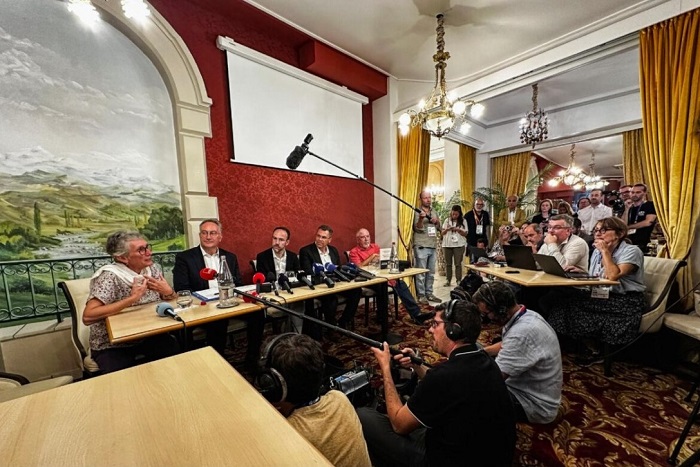
[Photo above: After a nearly two-hour meeting with Pope Leo XIV Sept. 27, 2026, survivors of abuse by members of French clergy, Veronique Garnier, Olivier Mardi, Jerome Guillement, Bertrand Virieux, and Jean-Marie Delbos, speak to journalists in Lourdes. (OSV News photo/Clotaire Achi, Reuters)]
French survivors of clergy sexual abuse who met with Pope Leo XIV in Lourdes said they were struck by the pontiff’s deep personal empathy and his frank acknowledgment of the institutional failures that allowed the crisis to fester within the Church.
Speaking at an invitation-only press conference in Lourdes following the Sept. 27 audience, five of the seven survivors who took part — Véronique Garnier, Olivier Mardi, Jérôme Guillement, Bertrand Virieux, and Jean-Marie Delbos — said the encounter shattered their expectations. Two other participants chose to remain anonymous.
According to the Vatican, the pope met with the survivors — four men and three women — individually and as a group. “Pope Leo expressed his closeness to them and, through them, to all those who have suffered and still suffer from the wounds of the abuse they endured,” the Vatican said.
Delbos, 80, who was abused as a child while attending the Notre-Dame de Bétharram boarding school, said that despite having left the Catholic Church six decades ago, he was overwhelmed by emotion.
“When he saw what state I was in, he took me in both arms,” Delbos recalled. “I never imagined it would be the pope holding me. It was an extraordinary moment.”
Guillement, who was abused as a teenager by his parish priest and now leads a survivors’ panel working with French Catholic schools, said he urged the pope to focus on prevention “not through endless training modules or procedures, but prevention rooted in real culture change.”
He also noted that Pope Leo “has a very clear opinion” on the systemic nature that allowed the clergy abuse crisis to persist.
“From his point of view, abusers are individuals, sure, but what creates the space and allows these abusers to keep offending is the systemic structure within the institution — a structure that was there in the past, but in his eyes, is still very much in place,” Guillement said.
“That point struck me as particularly powerful, because it highlights — as he stated repeatedly — just how pervasive this systemic issue remains,” he added. “He emphasized repeatedly that, even though significant work has been done in France — and he acknowledges his own substantial contribution there — the Church in France still has a great deal more to do.”
Asked by a reporter whether the pope formally acknowledged the systemic nature of abuse, Guillement replied, “Absolutely.”
The pope, Guillement recalled, stressed that abusers “are individuals, distinct individuals. But the way they can — and have — spread over time is really linked to the systemic dimension.”
“And he added: ‘I speak of it in the past tense, but it is a dimension that is still present — this systemic dimension,’” Guillement said.
From skepticism to guarded hope
Garnier, who was abused by a priest in the Diocese of Nancy, admitted she was skeptical going into the audience, especially after attending the papal Mass at Lourdes, where she felt overwhelmed by the blaring music and crowds.
In contrast, she described the private audience as “an encounter with a simple man.”
Because the meeting began earlier than scheduled, Garnier said she felt a “great sense of relief and joy in knowing I could say everything I wanted to because I had more time.”
“He has a very, very strong presence, yet it’s gentle and simple,” she recalled. “At one point, he told us to eat some cookies — just to eat. It was something easy, something that I think truly speaks of a hope that things can change.”
The pope, she continued, “listened deeply” and “not just superficially with nice words that would never lead to anything substantial.”
Regarding the systemic nature of abuse, Garnier said she told the pope she disagreed with the country’s bishops’ assessment that the Church in France has “moved beyond the systemic problem.”
“I told the pope, ‘No, no, no; we haven’t moved past it,’ and I think he is well aware of that,” she recalled.
“It wasn’t just a matter of a few vulnerable children being in the wrong place at the wrong time, either,” Garnier added. “No, the system itself is involved — the proof lies in what we experienced. I hadn’t intended to focus so much on the collective aspect, but ultimately, that is where the conversation leads: it is a systemic problem.”
An unexpected sign of the cross
Delbos described himself as a “notorious nonbeliever,” who had left the Catholic Church since his abuse 65 years ago.
Yet he was amazed to be present at the papal Mass in Lourdes, admitting he was “deeply moved,” and even more so during his meeting with Pope Leo.
“Making the sign of the cross — you wouldn’t have expected that from me,” Delbos told journalists. “But I swear, when he gathered us and said, ‘I am going to bless you,’ I made the sign of the cross. Even a notorious non-believer like me — that man made me make the sign of the cross after 65 years.”
While the pain of his abuse would remain for the rest of his life, Delbos admitted that he has a new perspective on “what the Church is, and who this pope is.”
“He really shook me up,” he said. “And I’m not usually the type of person who gets emotional easily. But I can tell you, I felt something there I never would have imagined.”
Delbos said he told the pope about the abuse he suffered at Notre-Dame de Bétharram. According to the Reuters news agency, some 250 complaints were filed in 2025 by former students who were abused at the Catholic boarding school since the 1950s.
The survivor said he told Pope Leo that the priest who abused him “was promoted” within his congregation, the Bétharram Fathers, and was never punished, adding that he asked for the religious congregation to be dissolved.
“I understand that dissolving a congregation will not happen in the coming days. There will certainly be studies of possibilities,” Delbos said. “But he listened. And just having the pope listen to a poor wretch like me propose something like that — I must admit it gave me great confidence.”
“We will see what happens,” he said.
– – –
Junno Arocho Esteves is an international correspondent for OSV News. Follow him on X @jae_journalist.