
(UNITED KINGDOM)
EU Today [London, England]
November 24, 2026
By Gary Cartwright
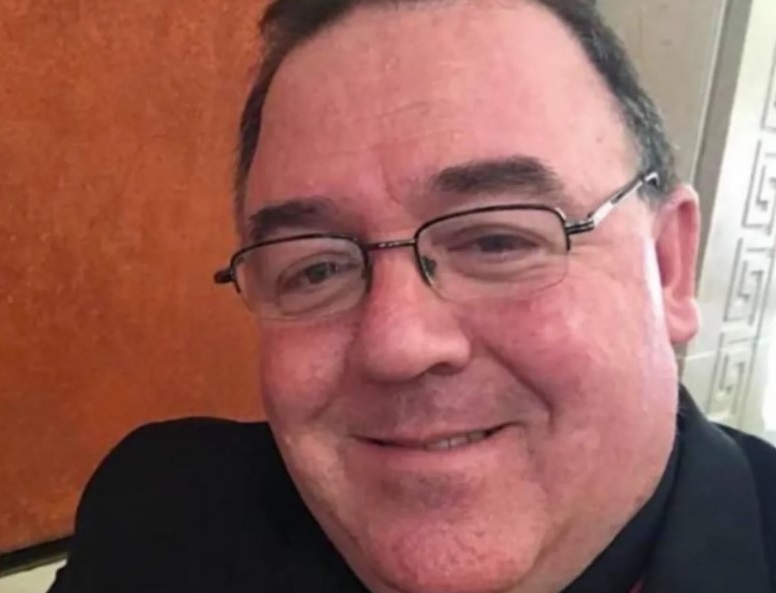
[Photo above: Father Edward Gallagher, Diocese of Derry, Ireland.]
Ireland’s troubled history of institutional abuse casts a long shadow over the latest revelations involving Father Edward Gallagher.
The case of Father Edward Gallagher, who has pleaded guilty to 109 child sex offences, raises deeply troubling questions about the Diocese of Derry, the Catholic Church’s safeguarding record and whether Ireland’s religious establishment has really learned anything from decades of scandal.
The Catholic Church in Ireland is once again facing uncomfortable questions about its treatment of children, the conduct of its clergy and the accountability of those responsible for overseeing them.
The case of Father Edward Gallagher, a Catholic priest from the Diocese of Derry, is particularly disturbing. Gallagher, aged 59, has pleaded guilty to 109 offences relating to the online sexual abuse of male children, committed between June 2023 and April 2025. His offences include attempting to communicate sexually with children, attempting to encourage them to distribute indecent images and possessing child sexual abuse material. He is due to be sentenced in December 2026.
The scale and nature of the offences are appalling. But the questions arising from this case extend beyond the criminal responsibility of one individual.
Bishop Michael Router has announced that he intends to petition the Vatican for Gallagher’s permanent dismissal from the priesthood. More significantly, following further concerns about Gallagher’s previous missionary service in Belize, the bishop has commissioned an independent external review of how information about the priest was obtained, handled and acted upon.
The diocese has stated that it received no formal complaint alleging criminal conduct during Gallagher’s time in Belize. Nevertheless, questions have been raised publicly about his activities there and his subsequent return to Northern Ireland.
An independent investigation is therefore welcome. But it must be genuinely independent, comprehensive and transparent. The Catholic Church cannot expect the public simply to accept assurances that everything was handled appropriately.
Ireland’s deeply uncomfortable history
To understand why this latest case attracts such scrutiny, it is necessary to consider Ireland’s history of institutional abuse.
For much of the twentieth century, the Catholic Church exercised extraordinary influence over Irish society. Its authority extended into education, healthcare, family life and public morality. Religious orders operated schools, industrial institutions, orphanages and mother-and-baby homes, frequently with the cooperation or acquiescence of the Irish State.
The consequences were devastating. The 2009 Ryan Report documented decades of physical, sexual and emotional abuse in religious-run institutions. The Murphy Report exposed the Dublin Archdiocese’s catastrophic handling of allegations against abusive priests, revealing a culture in which protecting the institution’s reputation frequently took precedence over protecting children.
The revelations surrounding Tuam were equally disturbing. As explored in EU Today’s Ireland’s Shame Unearthed: The Children of Tuam and the Chamber Beneath the Playground, the former St Mary’s Mother and Baby Home became a symbol of the extraordinary cruelty and institutional indifference suffered by vulnerable women and children.
The discovery that 796 children had died at the institution, with their remains buried in an unmarked and previously unidentified burial site, shocked international opinion.
More recently, EU Global revisited this history in Ireland’s Far Right Wants to Rewrite History: The Children of Tuam Must Not Be Forgotten, examining attempts to rehabilitate aspects of Ireland’s institutional past and the importance of preserving historical accountability.
These were not simply unfortunate episodes involving individual members of religious orders. They reflected a wider institutional environment in which authority, secrecy and deference combined to leave vulnerable people without adequate protection.
Has anything really changed?
In a recent EU Today article, The Catholic Church’s Abuse Scandal: Has Anything Really Changed?, I examined the continuing international consequences of clerical abuse and the Church’s apparent difficulty in moving beyond expressions of regret towards meaningful accountability.
The central problem is not that the Catholic Church has failed to apologise. It is that apologies have too frequently been accompanied by inadequate transparency, institutional defensiveness and an apparent reluctance to confront the failures of senior officials.
There have undoubtedly been improvements in safeguarding procedures. It would be unfair to suggest that the entire Catholic clergy should be judged by the actions of individual offenders. Many priests and religious organisations perform valuable work in their communities.
Nevertheless, the Gallagher case demonstrates why safeguarding cannot simply be regarded as an administrative requirement. It must be an institutional priority.
The independent review must establish whether any warning signs were missed, whether information was appropriately shared and whether the diocese fulfilled its responsibilities. It should also examine the questions surrounding Gallagher’s missionary service in Belize, without prejudging allegations that have not been established.
There is an additional responsibility on the Vatican. Removing a priest from the clerical state is an important disciplinary measure, but it cannot substitute for cooperation with civil authorities or the pursuit of justice for victims.
The price of institutional self-preservation
Ireland’s historical experience demonstrates what can happen when religious authority is allowed to operate without sufficient scrutiny.
For decades, allegations of abuse were sometimes dealt with internally. Accused priests were moved, complaints were inadequately investigated and victims were discouraged from speaking out. The consequences extended across generations.
The Catholic Church cannot reasonably expect the public to forget that history simply because new safeguarding policies have been introduced.
Pope Leo XIV has an opportunity to demonstrate that his papacy will be different. His engagement with abuse survivors is welcome, but symbolic gestures must be accompanied by concrete action.
That means independent investigations, access to Church records, meaningful support and compensation for victims, and full cooperation with the police and judicial authorities.
It also means holding senior officials accountable where evidence establishes that they concealed abuse or failed to protect children.
A question of moral authority
The Catholic Church continues to claim a central role in defining moral standards and defending traditional family values. Such a position carries responsibilities that cannot be separated from its treatment of the most vulnerable members of society.
The Gallagher case is not simply another unfortunate episode involving an individual priest. It is an opportunity, and a test, for the Diocese of Derry and the wider Catholic hierarchy to demonstrate that institutional accountability is finally being taken seriously.
Ireland has spent decades uncovering the consequences of religious institutional failure. The victims of those failures deserve more than apologies, inquiries and promises that lessons have been learned.
Faith deserves respect. The Catholic Church, however, deserves no immunity from scrutiny.
Ultimately, the credibility of any religious institution rests not on the authority it claims, but on the way it treats those entrusted to its care.
The protection of children must always come before the protection of the Church’s reputation. Until that principle is demonstrated consistently in practice, the Catholic Church’s Irish abuse scandal will remain unfinished business.
Gary Cartwright is the publisher and editor of EU Today. He is a member of the Chartered Institute of Journalists, and a former adviser to UK Members of the European Parliament. He is the author of two books, Putin’s Legacy: Russian Policy and the New Arms Race (2009) and Wanted Man: the story of Mukhtar Ablyazov (2019)