|
Introduction to the Archives
The core of BishopAccountability.org's library and online holdings is a remarkable collection of tens of thousands of diocesan and religious order documents. On this page, we provide an overview of that document collection. We describe the archives and the circumstances of their release, with links to selected archives, and we offer a sampling of individual documents.
The archives were made public in connection with sexual abuse complaints, after criminal investigations or document discovery in litigation. But the significance of the archives transcends the legal proceedings from which they emerged, and the often protracted battles to unseal some of the files. After the court orders and the settlements, a treasure trove of documents is now in the public domain. But the archives are scattered in courthouses from Maine to California – our goal is to gather them all and make them more easily accessible to the public.
This archive of archives is of course vitally important for anyone working to understand sexual abuse and its mismanagement in the Catholic church. As such, the archives complement our database of accused priests, our collection of investigative reports, our blog of daily news coverage, our collection of survivors' accounts, and our archives of church documents.
But the document archives also offer a remarkably detailed case study for anyone working on sexual abuse and harassment in other institutions, and for scholars working on institutional response to crises. The archives will also be of great interest to anyone concerned with issues in Catholicism other than the sexual abuse of children – day-to-day church operations, episcopal relationships with the Vatican, ministry to ethnic communities, changes before and after the Second Vatican Council, and countless other topics.
Church Archives
Hundreds of thousands of secret church documents have been obtained in criminal investigations of sexual abuse and document production in civil suits, mostly in the United States, but also in Canada, Ireland, England, France, Belgium, and other countries. Most of the documents pertaining to sexual abuse have been found in the secret archives files of accused priests. These files are maintained by dioceses and provinces of religious orders worldwide as directed by the Code of Canon Law:
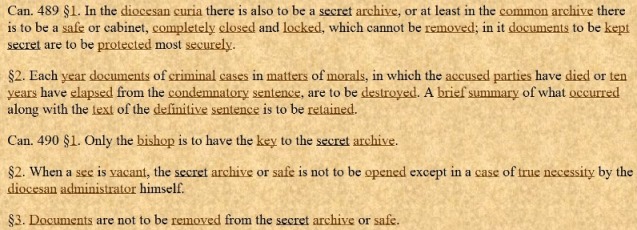 |
Other sexual abuse documents have been found in the laicization files of accused priests and in other diocesan and religious order files. In addition, documents that do not pertain directly to sexual abuse have been found in the accused priests' personnel files. Bishops and superiors of religious orders have fought the release of all these files and have claimed privilege to withhold many documents. They have in some cases destroyed documents.
But a remarkably rich and important record has survived. Below we sketch the provenance of some representative archives, and provide links to complete archives and selections, so that the reader can explore the collection. Then we offer links to dozens of individual documents, to provide another means for assessing the archives.
Our Archives and the Circumstances of Their Release
Investigative Archives
Hundreds of criminal investigations of child abuse in the Catholic church have been undertaken by government authorities, and in the United States, grand juries and attorneys general have released reports on their investigations of the following dioceses: New York NY (2002), Rockville Centre NY (2003), Manchester NH (2003), Boston MA (2003), Philadelphia PA (2003, 2005, 2011), and Portland ME (2004). The inquiries in Ireland were carried out by nationally mandated commissions and examined three dioceses (Ferns [2005], Dublin [2009], and Cloyne [2010]), and the institutions run by Catholic religious orders (2009). In the Dublin archdiocese, Archbishop Martin gave the Dublin documents to the Murphy Commission over the objection of his predecessor, Cardinal Desmond Connell. The U.S. and Irish investigations quote documents obtained from the dioceses and religious orders.
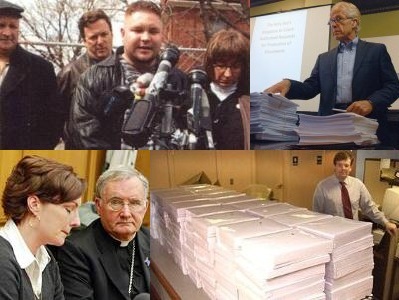
In addition to the quotations in the reports linked above, two investigations released documents to complement their analysis. The 2005 Philadelphia Grand Jury Report included a document appendix containing 31 documents from archdiocesan files. The 2003 New Hampshire Attorney General's report included document appendices containing 8,601 pages of diocesan and investigative files. In order to avoid prosecution of the diocese for violation of child protection statutes, Bishop John B. McCormack of the Manchester diocese agreed that the Attorney General of New Hampshire would release a report and the archive, and would audit the diocese for five years to ensure compliance with the law. The investigative documents from the audit were released under New Hampshire's freedom of information act on March 7, 2009 and March 26, 2009. (Senior Assistant Attorney General Will Delker, now a Superior Court judge in New Hampshire, is pictured above, bottom right, at the time of the document release.)
BishopAccountability.org has posted online the Philadelphia documents and the large Manchester archive, with audit documents, in their entirety. These documents are also available from the District Attorney of Philadelphia and the New Hampshire Attorney General.
Diocesan and Religious Order Archives
Filed with the Courts and Released in Settlements
The U.S. bishops report that they have received complaints of sexual abuse regarding 6,115 priests from 1950 to 2011, excluding 2003. We estimate that more than 4,000 civil suits have been filed in the U.S. courts during that time, and in most of these cases, documents from the priest's personnel and secret archive files have been produced by dioceses and religious orders under subpoena. Some of these documents have been publicly filed with the courts, and some have been publicly released under the terms of omnibus settlements and in accord with court orders. BishopAccountability.org has gathered tens of thousands of pages of these publicly available church files. We have posted some archives in their entirety, and we have posted selections from the others.
Archives Filed with the Courts
In the mid-1980s, attorneys representing victims of clergy abuse and journalists writing about the first cases began to learn about the system of church files. Media coverage of attorney Jeffrey Anderson's groundbreaking work on the case of the Rev. Thomas P. Adamson shows the state of the art at that time. (Anderson is pictured above, top right, announcing in 2011 the first production by the Vatican of abuse-related documents.) In the 1990s, reporters were sometimes able to obtain church files and quoted from them in coverage of several important cases. See, for example, the work of Boston Globe reporters on the case of Rev. James R. Porter, and Dallas Morning News reporters' detailed account of the Rev. David A. Holley documents.
Despite the outward appearances of the bishops' Restoring Trust program (see their 1994 and 1995 reports), which was prompted by the Porter revelations, dioceses and religious orders in fact responded to the document-based work of journalists with measures to keep subsequent cases secret. The church asked judges to impound the court records of sexual abuse suits, and judges routinely complied. Settlements were negotiated in secret, and victims were made to sign confidentiality agreements as a condition of compensation. Security was enhanced and documents were shredded. A window on those developments was provided by documents that were at issue in the trial of Msgr. William J. Lynn.
In 2002, this secret system began to be exposed by Boston Globe reporters working on the Rev. John J. Geoghan case and the allegations against Rev. Paul R. Shanley and other Boston priests. By early December 2002, events in Boston had set the scene for the archival emphasis that we see today, and the church was forced to renounce confidentiality agreements. The release of documents has increasingly become a nonmonetary demand of settlements involving multiple victims. Quiet settlements under arbitration have proved to be more durable, however, in Boston and elsewhere.
The Sea Change of the Geoghan Case – The evolution toward the major document releases of the last ten years began with a lawsuit filed on July 9, 1996, by attorney Mitchell Garabedian on behalf of three victims of Geoghan. Many other Geoghan victims came forward in the late 1990s, and in September 2000, Judge James Hughes granted a motion by the Boston archdiocese to seal the files of all the Geoghan complainants. The Boston Globe filed suit to have the files, made public, and in November 2001, Judge Constance Sweeney unsealed the court records of 86 Geoghan plaintiffs. The archdiocese appealed, arguing separation of church and state. On December 21, 2001, Judge Cynthia Cohen rejected the archdiocese's appeal, and on January 24, 2002, the Geoghan documents were released. Our holdings comprise 8,478 pages of depositions and Geoghan's own files; see a selection of Geoghan's documents. The Globe then found that the court files of suits alleging abuse by other priests also appeared to be impounded, and the newspaper successfully filed suit to unseal the court files of three more priests.
Pattern and Practice and the Shanley Case – On February 13, 2002, attorney Roderick MacLeish filed the lawsuit Ford v. Law on behalf of a man who claimed he had been molested by Rev. Paul R. Shanley. (Mr. Ford is shown with his parents Rodney and Paula, and Mr. MacLeish, in the photo on the upper right above.) On April 4, 2002, Judge Leila R. Kern denied the Boston archdiocese's motion for a gag order on Shanley documents to be provided to the plaintiffs. The first production occurred the next day, and the documents were made public on April 8, 2002. See a selection of the Shanley documents. MacLeish then subpoenaed the files of more than 140 accused Boston priests to establish archdiocesan pattern and practice.
Those documents started to be publicly filed on December 3, 2002, precipitating the resignation of Cardinal Bernard Law on December 13, 2002. As priest files continued to be produced in 2003 and filed with the court, the documents at the courthouse became the largest de facto public archive of priest personnel and secret archive files. BishopAccountability.org has acquired a nearly full set of the public Boston files, a total of 28,035 pages, and we provide an online selection of 1,569 pages from those files, together with MacLeish's pattern and practice brief. On December 10, 2002, less than a week after the first filing of Boston documents, the Attorney General of New Hampshire finalized with Bishop John B. McCormack an agreement for the eventual release of the Manchester diocesan and investigative files. McCormack had handled Boston abuse cases as Cardinal Law's delegate in 1993-1994.
Archives Released in Settlements
The court-ordered release of documents from the files of Geoghan, Shanley, and other Boston priests in 2002 established a precedent. For example, newspapers filed suit to unseal church documents in the Fort Worth and Bridgeport dioceses. After long legal battles (ten years in Bridgeport, going all the way to the U.S. Supreme Court) the documents were released, and we have the complete collections in our holdings:
• Diocese of Fort Worth – 659 pages – released November 28, 2006 – see the entire Forth Worth archive
• Diocese of Bridgeport – 11,187 pages – released December 1, 2009 – see a 494-page online sample of the Bridgeport archive
The Boston experience in 2002 also established a best practice for the omnibus settlements that were concluded by dioceses and religious orders in subsequent years.
Those settlements increasingly used nonmonetary provisions to obtain child protection commitments and the release of priest personnel and secret archive files. (Instrumental in that effort was Joelle Casteix, pictured above, bottom left, with Bishop Tod Brown of the Orange diocese.) Some of the most significant document settlements were:
• Diocese of Orange – 3,399 pages – released May 17, 2005 – see articles 1 2 with links to Orange documents
• Archdiocese of Portland – 3,132 pages – released beginning June 4, 2007 – see the archdiocese's own website
• Dioceses of San Diego and San Bernardino – 9,971 pages – released October 24, 2010 – see the entire archive
• Diocese of Wilmington – 11,245 pages plus 87 depositions and 56 transcripts – released February 15, 2012 – see selections
• Franciscans in California – 4,483 pages – released May 28, 2012 – see the entire archive
The above summary describes only a portion of our holdings, which also include important collections of documents from the files of the Jesuits and the Servants of the Paraclete, complete files of many other accused priests, documents obtained from the Vatican in discovery, files of accused priests who have worked in Mexico, and trial transcripts and exhibits. We will post an additional 20,000 pages of files by year end, and we are constantly acquiring new archives.
Sample Documents in the Archives
Accounts by Survivors and Family
• Exchange between Archbishop Kelly of Louisville and the Family of a Survivor of Rev. Louis E. Miller
• Survivor's Wife: "During
my childhood and up until now, my heart would always beat
a little faster as I received Communion."
• Survivor's Parents: "It
seems you have forgotten that our son is the victim."
• Survivor's Wife: "The
most damaging of the information that I discovered was from
a retired nun."
• Archbishop Kelly: "I
deeply regret your present circumstances, but I do not find
myself able to alleviate them in any way."
• Survivor's Parents: "They
were made to feel more like the criminals instead of victims."
• Archbishop Kelly: "The
restrictions Miller gracefully accepted on his work."
• Living on a Fault Line, letter faxed to the Boston archdiocese by a survivor of Rev. Richard T. Coughlin (12/16/92)
• Mother's Letter about Rev. Mario Cimmarrusti OFM's Abuse of Her Son and Its Effects on the Family (11/27/92)
• Memo by Sister Catherine Mulkerrin to Rev. John B. McCormack Reporting Allegations of Abuse by Rev. Robert V. Meffan (2/3/93)
• Memo by Mulkerrin to McCormack Reporting Specific Allegation of Abuse by Meffan (2/19/93)
• Memo by Mulkerrin to McCormack Reporting Another Allegation of Abuse by Meffan (4/16/93)
• Memo by McCormack Considering Ministry for Meffan (7/6/93)
• Letter from a Survivor to Rev. Lawrence C. Murphy (2/12/95)
• Letter from a Survivor to Rev. Arthur L. Wood (4/25/95)
Priests' Accounts and Writings
• Newsletter by Rev. Paul R. Shanley – During 1972
and early 1973, Shanley wrote a newsletter and distributed it to a mailing
list with the help of his secretary, Eileen Mulcahy. Several hundred pages
of this newsletter are preserved in archdiocesan files. See Shanley's
introduction to this writing project, in his Christmas
letter of 1971.
• Letter
#3: The Hermit of Terrible Mountain or "The Street Priest" [Received 3/8/72]
• Letter
#4: Throwaways and Child of Clay
• Letter
#6: My Route; Covering Letter; Letter #7: Language and Respect; Letter
#8: Atheists and the Liturgy, and The Mountain, and The Holidays [Received
5/16/72; incorrectly Bates-numbered in reverse order; sequence corrected
here]
• Letter
#9: Diane Has a Baby; Letter #9A: A Sermon [Incorrectly Bates-numbered
in reverse order; sequence corrected here]
• Letter
#10: Finale and A Prayer for Runaways [back-dated 5/1/70]; Letter #11:
Communes [Bates order corrected]
• Letter
#11: Methadone [Dated 4/72 from Albuquerque]
• Sexual Autobiography, by Rev. Robert Van Handel OFM (mid-1990s)
• Letter to Cardinal Law by Rev. Robert V. Meffan (7/8/93)
enclosing autobiographical essay signed Prisoner of Love
• Affidavit of Rev. David A. Holley (7/12/93) with links to the documents cited
• Excerpt from Therapy Journal of Rev. Louis E. Miller (2/94)
• Emails by Rev. Joseph Palanivel Jeyapaul to Survivor (9/05)
Relations with the Vatican
• Notes by Very Rev. Gerald Fitzgerald sP to the Holy Office (4/11/62) with transcription
• Letter by Fitzgerald to Pope Paul VI (8/27/63)
• Exchange of Letters between Bishop Curtis of Bridgeport and then-Archbishop Vagnozzi, Apostolic Delegate, regarding a survivor of Rev. Laurence Brett (1966-1967)
• Cardinal
Seper at the Vatican's CDF Asks Medeiros to Explain Shanley's "Changing
Norms of Sexuality" Tapes (11/14/78)
• Letter
from Cardinal Medeiros to Vatican about Shanley, Homosexuality, and Seminaries (2/12/79)
• Seper's
Response to Medeiros' Letter about Shanley (3/27/79)
• Medeiros
Updates Seper on Shanley at St. Jean's (7/4/79)
FAQs Regarding Management of Accused Priests
with Documents from the Boston Archdiocesan Files
• Is
the survivor experience ever expressed in these archives? - David
Coleman called this amazing essay "Living on a 'fault' line."
It exists in the diocesan files because he faxed it to John B. McCormack,
a decade after he'd told McCormack the same story in person. Only after
the second communication was the accused priest investigated in California,
where five other victims came forward. (See other documents on Fr.
Richard T. Coughlin.)
• Is
the experience of the parents of survivors represented in the archives? - In this remarkable letter, a mother begs Cardinal Medeiros to keep Geoghan
away from other children. Medeiros's reply,
urging her to "love the sinner," is in stark contrast to the
moral clarity that the mother showed. (See other Geoghan documents.)
• How
do dioceses keep track of a priest's career? - Every diocese keeps
assignment records on its priests, like this record for Boston abuser
Joseph Birmingham. If they were made public for all known abusers, these
records would help other victims to come forward, and would allow tens
of thousands of U.S. parishes to assess the harm they have experienced
during the last fifty years. But dioceses don't release these records
except under duress. These records only tell part of the story, however,
because they generally don't list treatment centers to which the priest
had been sent. (See other documents on Birmingham.)
• Did
worried parents ever try to get information about a priest's career? - Dioceses used the borders between parishes to restrict information about
abusers and facilitate their quiet transfer. In this document, a fearful
parent requests information about Fr. Joseph Birmingham.
• Are
there examples of such requests being rebuffed? - Fr. John McCormack
deflects the parent's question, although McCormack knew that there were
already allegations against Birmingham in the chancery files, and indeed
had personal experience of Birmingham's behavior.
• Did
the dioceses keep track of allegations? - This detailed chronology
of allegations against John Geoghan was written in 1994. A few years later,
Cardinal Law granted Geoghan's request for Senior Priest Retirement Status, praising his "effective life of ministry, sadly impaired by illness."
• Do
priests ever try to "do the right thing" in the diocesan files? - This letter was written in 1967 by Fr. Arthur Chabot about Fr. Paul
Shanley. Thirty years and two cardinals later, Shanley's record was still
being concealed. (See other documents on Shanley.)
• Do
the files offer any examples of harmful clericalism? - This letter
from John Geoghan's pastor, denigrating a credible abuse complaint in
the middle of the priest's sorry career, is one of the worst examples
of this clericalism, especially read with Bishop Daily's reply to him.
• Did
bishops ever try to "do the right thing"? - In Boston, only
Bishop John M. D'Arcy cared about vulnerable children and proper discipline
among priests. In this letter he expressed concern to Bishop Thomas V.
Daily about Fr. Richard Buntel, an abuser and a drug dealer who remained
in service for another decade. Shortly after another letter,
this one to Cardinal Law about John Geoghan, D'Arcy was shipped off to
South Bend, despite his request that he be allowed to stay with his gravely
ill mother in Boston. (See other documents on Buntel and Geoghan.)
• Did
bishops sometimes lie in order to transfer priests to unsuspecting new
dioceses? - Bishop Banks told the San Bernardino diocese that Paul
Shanley was a priest in good standing, thirty years after the Boston archdiocese
began to receive allegations against the priest.
• When
bishops told the truth, were they heeded? - Boston had learned from
Youngstown that Robert Burns had a "problem: little children."
(See the notes at the bottom of that document, and also the affidavit of the "sending" bishop.) Yet Cardinal Medeiros placed Burns
in St.
Thomas Aquinas in Jamaica Plain, and Cardinal Law placed him at St.
Mary's in Charlestown. After Burns was sentenced to prison in New
Hampshire for sexual abuse, an incredulous survivor questioned a Boston abuse bureaucrat about the Burns placements. (See other documents
on Burns.)
• What
does a treatment center report look like? - Treatment centers are
an important link in the quiet transfer of abusers into unsuspecting parishes
and dioceses. This report from the Institute of Living on Joseph Birmingham
provides a window into the process. Its assessment of Birmingham is complacent
and inaccurate, but even its mild recommendations were ignored by Cardinal
Law. Birmingham was subsequently assigned to a parish without restriction,
and without telling the parish about his past.
• Is
there any evidence that dioceses manipulated the treatment centers? - In this letter, Bishop Robert J. Banks makes clear that he wants a more
upbeat assessment. He receives an Orwellian but compliant answer.
• What
do the diocesan files tell us about Review Boards? - In this 1994
document, the Boston Review Board recommended that an abusive priest not
be allowed to say weekend Mass. Fr. Thomas P. Forry had over the years
been accused of assaulting his housekeeper and abusing several boys, and
had abandoned a woman after a clandestine live-in relationship of many
years. But the Review Board reversed
itself in the next year (see Law's explanation),
and then closed
the case. These and other documents raise serious questions about
the independence of consultative boards and their relationship with diocesan
abuse bureaucrats. Even after bad behavior as a prison chaplain, Forry
was filling in at parishes, until a victim who encountered him at Mass complained,
and Forry was finally removed during the 2002 Geoghan and Shanley revelations.
(See other Forry documents.)
• Do
the documents offer any unexpected insights? - If this Canadian priest's
insight into an abuser's "dual life," written in 1968, had been
heeded by the Boston archdiocese, one woman's life would certainly have
been saved. If the lesson had been applied to the hundreds of other abusers
in Boston, a better policy would have emerged much sooner, and many survivors
would never have been abused. (See other documents on Fr.
James D. Foley.)
• Have
these documents ever had a major effect on the crisis? - These notes
(pictured above) by Fr. John B. McCormack on a 1993 meeting between Cardinal
Law and Fr. James D. Foley probably resulted in Law's resignation. In
the meeting, Foley revealed that he had abandoned one of his female victims
during a fatal drug overdose. Despite this admission, Foley continued
to serve in parishes for almost ten years, well beyond the bishops' Dallas
meeting. He was removed only when the archdiocese accidentally released
his file, mistaking him for another Foley, and the story came to light.
Law resigned a few days later.
|